

The Case for Demanding Evidence Based IOP Therapy
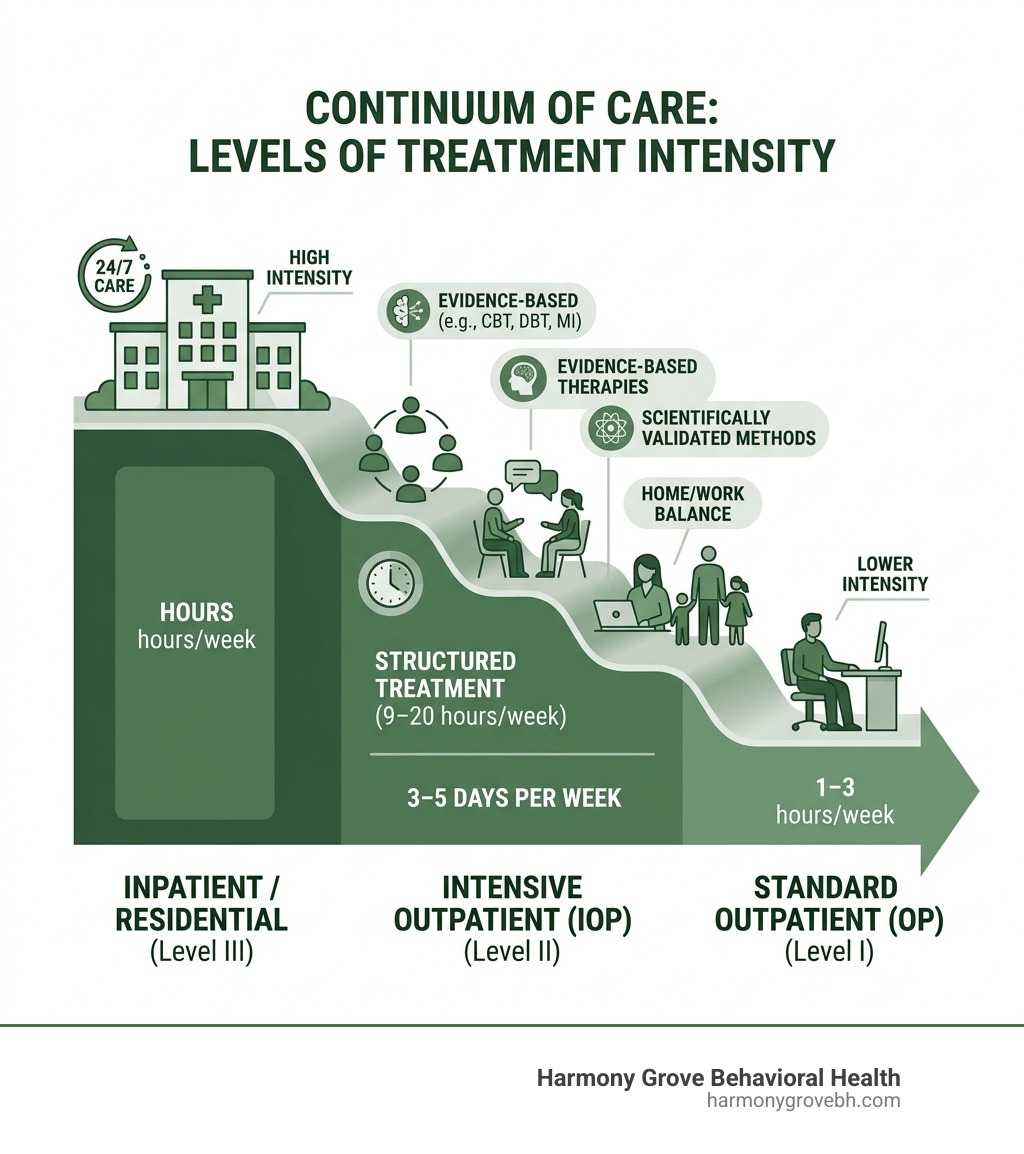
Evidence based IOP therapy is a structured form of intensive outpatient treatment that uses scientifically validated methods — like Cognitive Behavioral Therapy (CBT), Dialectical Behavior Therapy (DBT), and Motivational Interviewing (MI) — to treat addiction and co-occurring mental health conditions, typically 9–20 hours per week, without requiring an overnight stay.
Quick answers for people researching evidence-based IOP:
| Question | Answer |
|---|---|
| What is it? | Structured outpatient treatment using proven, research-backed therapies |
| Who is it for? | Adults with substance use disorders, mental health issues, or both |
| How many hours per week? | 9–20 hours, usually 3–5 days per week |
| How long does it last? | Typically 8–12 weeks, based on individual progress |
| Is it as effective as inpatient? | Yes — research shows 60–70% abstinence rates at six months, comparable to residential care |
| Is it covered by insurance? | Most commercial plans cover it as a medically necessary level of care |
Here’s the uncomfortable truth: not all outpatient programs are created equal.
Some programs call themselves “intensive” but rely on outdated methods with little scientific backing. Others mix and match therapies without a clear clinical framework. The result? Patients put in the work but don’t get the outcomes they deserve.
The difference between a program that works and one that doesn’t often comes down to one thing: whether the therapies are evidence-based.
Research published in Psychiatric Services rated substance abuse IOPs as having a high level of evidence — comparable in effectiveness to residential or inpatient care for most adults. And SAMHSA’s Treatment Improvement Protocol 47 sets the clinical standard for how these programs should be designed and delivered.
If you’re a working professional in Houston balancing a demanding career, family obligations, and a real struggle with alcohol, drugs, or trauma — you need a program that actually works. Not one that just sounds good in a brochure.
This guide breaks down exactly what makes an IOP evidence-based, which therapies have the strongest research behind them, and why settling for anything less could cost you your recovery.
Defining Evidence Based IOP Therapy and Its Core Principles
When we talk about evidence based iop therapy, we aren’t just using a buzzword. We are referring to a specific standard of clinical rigor. According to the American Society of Addiction Medicine (ASAM), an Intensive Outpatient Program (IOP) is classified as Level II care. This means it sits right between standard outpatient counseling and high-intensity residential treatment.
To be truly “evidence-based,” a program must follow the standards set by organizations like SAMHSA. These programs aren’t just “talking about feelings”; they are utilizing a structured psychotherapy curriculum that has been tested in clinical trials and peer-reviewed studies.

The core principles of an effective evidence-based IOP include:
- Multidisciplinary Collaboration: Your care team shouldn’t just be one person. It should involve therapists, psychiatrists, and case managers working together.
- Individualized Assessment: No two recoveries are the same. A “one-size-fits-all” approach is the opposite of evidence-based care.
- Outcome Tracking: How do we know you’re getting better? We use metrics and assessments to measure progress.
- Intensity and Structure: For adults, this typically means 9 to 20 hours of treatment per week. This intensity is what bridges the gap between “getting by” and “getting well.”
Research found in Substance Abuse Intensive Outpatient Programs: Assessing the Evidence confirms that when these principles are applied, the outcomes are consistently positive, often matching the success rates of much more expensive inpatient stays.
Proven Modalities: The Pillars of Evidence Based IOP Therapy
What actually happens during those 9 to 20 hours a week? In an evidence-based setting, every session is built on a “pillar” of proven therapy. We don’t guess; we use what works.
The most common clinical modalities used in high-quality IOPs include:
- Cognitive Behavioral Therapy (CBT): This is the workhorse of addiction treatment. It teaches you to identify triggers, challenge negative thought patterns, and role-play high-risk situations before they happen in the real world.
- Dialectical Behavior Therapy (DBT): Originally developed for complex emotional issues, DBT is incredible for teaching distress tolerance and emotional regulation—skills every person in early recovery needs.
- Motivational Interviewing (MI): This approach focuses on resolving your ambivalence. It’s okay to be unsure about sobriety; MI helps you find your own internal “why” for staying clean.
- 12-Step Facilitation: While AA is a community group, “12-Step Facilitation” is a clinical strategy to help patients engage with those community resources effectively.
- Relapse Prevention: This isn’t just a “don’t do it” talk. It’s a scientific approach to identifying the warning signs of a slip weeks before it actually occurs.
According to Chapter 8. Intensive Outpatient Treatment Approaches, combining these approaches—rather than sticking to just one—is often the most effective way to treat the “whole person.”
The Role of Trauma-Informed Care in Evidence Based IOP Therapy
We know that for many of our neighbors in Houston, addiction doesn’t happen in a vacuum. Often, it is a response to trauma. This is why we emphasize trauma-informed programming as a non-negotiable part of our care.
Trauma-informed care isn’t just a specific type of therapy; it’s a “lens” through which all treatment is viewed. It prioritizes:
- Safety: Ensuring the physical and emotional environment is secure.
- Empowerment: Giving the patient a voice and a choice in their treatment plan.
- Nervous System Regulation: Using techniques like mindfulness or trauma-informed yoga to help “calm” the brain’s fight-or-flight response.
Research shows that trauma-informed treatments can lead to symptom reduction in over 86% of PTSD cases in outpatient settings. By addressing relational healing and gender-specific needs, we help patients heal the root cause of their substance use, not just the symptoms.
Integrating Dual Diagnosis Support in Evidence Based IOP Therapy
It is a statistical reality: many people struggling with substance use are also dealing with depression, anxiety, or bipolar disorder. In the past, these were treated separately. Evidence-based care says that is a mistake.
Integrated treatment for co-occurring disorders means treating both the mental health condition and the addiction at the same time, in the same place, with the same team. This is a cornerstone of our IOP Houston services. When we integrate medication management with psychotherapy, we see significantly higher retention rates and lower levels of self-reported distress.
The Effectiveness and Practical Advantages of Evidence-Based IOP
Why do so many people choose evidence based iop therapy? Because it works, and it fits into a real life.
Statistics from various clinical trials show that IOPs produce outcomes comparable to residential treatment for many adults, with success rates of 60 to 70 percent at the six-month mark. This is a staggering number when you consider that patients in IOP are still living at home and facing real-world triggers every day.
The practical advantages of our IOP Houston Texas programs include:
- Real-World Application: You can learn a coping skill at 10:00 AM and practice it at a family dinner at 6:00 PM. That “real-time” practice builds self-confidence that a “bubble” environment like inpatient rehab can’t always provide.
- Cost-Effectiveness: IOP is typically nearly half the cost of residential treatment, making it much more accessible for families and individuals.
- Maintaining Responsibilities: You don’t have to quit your job or leave your children to get high-quality care.
- Community Integration: You start building your local Houston support network while you are still in treatment, rather than waiting until you “get home.”
Who is the Ideal Candidate for an Intensive Outpatient Program?
While IOP is powerful, it isn’t for everyone. It requires a certain level of stability.
The ideal candidate for an Intensive Outpatient Program Houston TX is someone who:
- Is Medically Stable: You do not require 24-hour medical detox or supervision.
- Has a Safe Home Environment: Your living situation is supportive of recovery (or you are living in sober housing).
- Has a Low Withdrawal Risk: You have already completed detox or have a low risk of acute withdrawal symptoms.
- Is Ready for Change: You have a “fluctuating readiness” but are willing to show up and do the work.
For many, IOP serves as a “step-down” care level after finishing a residential program. It provides a “safety net” as you transition back into full-time life in Houston.
Individualizing Your Path with Evidence Based IOP Therapy
One of the greatest myths about evidence-based care is that it’s “robotic” or “by the book.” In reality, the best lifelong support IOP in Houston is highly personalized.
We look at your specific functional impairment levels, your family support system, and your career goals. From there, we build a progress-based duration plan. Some people might need 8 weeks; others might benefit from 12 weeks with a gradual “tapering” of sessions.
We also integrate:
- Life Skills Training: Budgeting, job hunting, and time management.
- Community Reinforcement: Helping you find sober hobbies and friends in the Houston area.
- Telehealth Flexibility: For those days when Houston traffic makes it impossible to get across town, virtual options ensure you never miss a session.
Frequently Asked Questions about Evidence Based IOP
How long does evidence-based IOP typically last?
Most Houston IOP programs last between 8 and 12 weeks. However, because we focus on “progress-based duration,” the length is determined by your clinical necessity and individual milestones rather than a fixed calendar date.
How effective is IOP therapy?
It is highly effective. Research consistently shows that for most individuals, IOP in Houston results in success rates (60-70% abstinence) that are equal to residential care. The key is the “real-time” skill application; you aren’t just learning about sobriety; you are living it.
Does insurance cover evidence-based outpatient programs?
Yes. Because these are “evidence-based,” most commercial health plans recognize them as a medically necessary level of care. Our IOP Program Houston works with many major providers to ensure your behavioral health benefits are utilized effectively.
Conclusion: Securing Your Future with Harmony Grove Behavioral Health
Choosing a recovery path is one of the most important decisions you will ever make. You deserve a program that respects your intelligence, your time, and your need for a real-world solution.
At Harmony Grove Behavioral Health, we provide more than just a schedule of meetings. We offer a holistic, evidence-based Intensive Outpatient Program right here in Houston. By combining clinical rigor with trauma-informed care and lifelong aftercare support, we help you build a foundation that doesn’t just last for the length of the program—it lasts for a lifetime.
If you are ready to demand more from your treatment, we are ready to help. Our community-focused approach ensures that you are never alone in this journey. Whether you are stepping down from a higher level of care or seeking primary treatment that fits your busy life, our Houston team is here to guide you toward a healthier, more stable future.
Reach out to us today at our Houston location to schedule a confidential assessment and take the first step toward the recovery you deserve.