

When Medication Alone Isn’t Enough: What Holistic Depression Treatment Really Offers
Holistic depression treatment is a whole-person approach to healing that goes beyond medication to address the mind, body, and spirit together. It combines evidence-based therapies, lifestyle changes, natural supplements, and mind-body practices to treat the root causes of depression — not just the symptoms.
Quick overview of holistic depression treatment options:
- Natural supplements – Omega-3 fatty acids, St. John’s Wort, SAMe, Vitamin D, B-complex vitamins
- Lifestyle changes – Anti-inflammatory diet, regular exercise, sleep hygiene, sunlight exposure
- Mind-body practices – Mindfulness meditation, yoga, acupuncture, breathwork
- Therapeutic approaches – Cognitive Behavioral Therapy (CBT), talk therapy, somatic work
- Environmental and social support – Ecotherapy, peer support groups, community connection
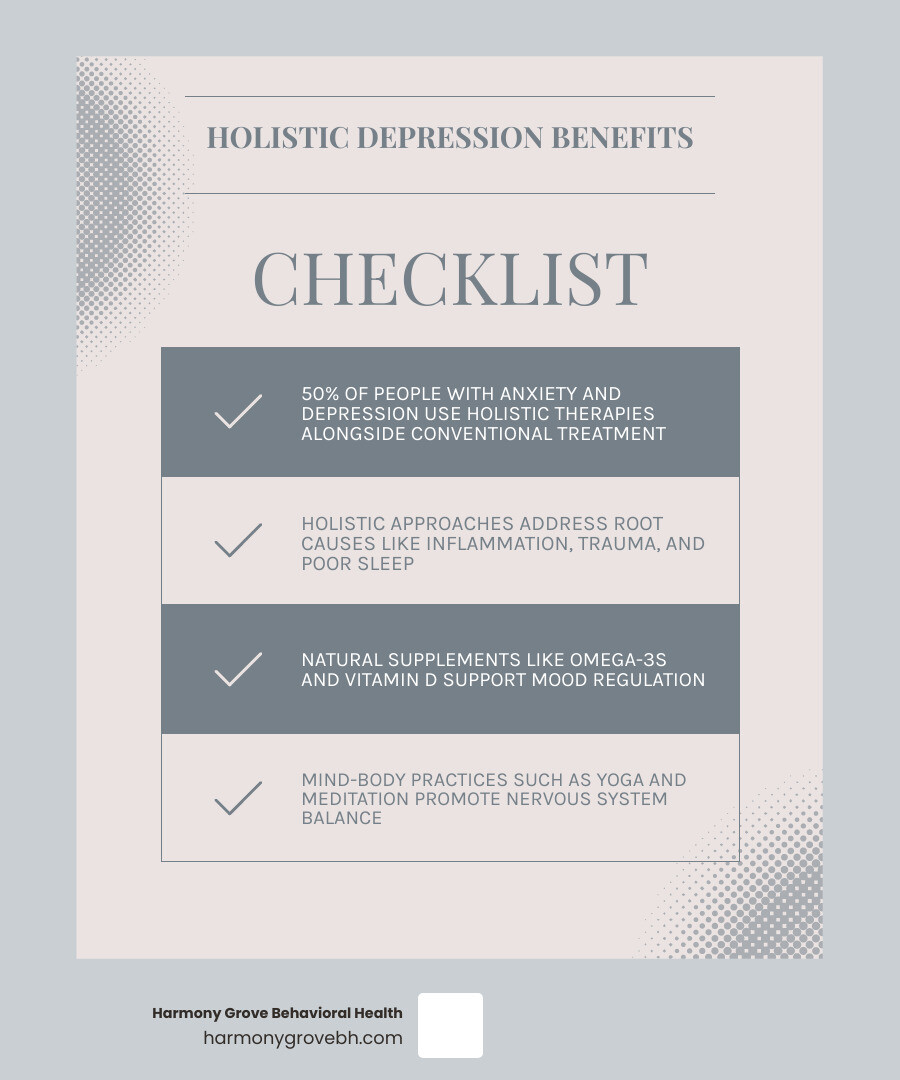
About half of people dealing with anxiety and depression already use some form of holistic therapy alongside — or instead of — conventional treatment. That’s not a fringe statistic. It reflects a real and growing recognition that depression is more than a brain chemistry problem.
Depression affects your entire being. Your sleep. Your gut. Your relationships. Your sense of purpose. For many people — especially those managing co-occurring stress, trauma, or substance use — a pill alone rarely addresses all of that.
That doesn’t mean medication is wrong. It means the full picture is bigger.
If you’ve tried antidepressants and still feel stuck, or you’re looking for ways to support your mental health more naturally and sustainably, holistic approaches may be the missing piece your recovery plan needs.
Understanding Holistic Depression Treatment vs. Conventional Medicine
For decades, the dominant way we’ve looked at mental health is through the “biomedical model.” This perspective suggests that depression is primarily a “chemical imbalance” in the brain—specifically a lack of serotonin or dopamine. Under this model, the solution is straightforward: take a pill to fix the chemistry.
While conventional antidepressants (like SSRIs) are life-saving for many, they often act as a “symptom suppressor.” They can lift the heavy fog of despair, but they don’t always address why the fog rolled in to begin with. Was it chronic inflammation? A lack of social connection? A history of trauma that has left your nervous system stuck in “survival mode”?
In contrast, holistic depression treatment operates through an integrative psychiatry lens. We look at the “multiple hits hypothesis,” which suggests that depression isn’t caused by one thing, but by a accumulation of stressors—biological, psychological, and social. Instead of just “fixing a broken brain,” we aim to “tune the whole orchestra.”
| Feature | Conventional Medicine | Holistic Approach |
|---|---|---|
| Primary Focus | Brain chemistry and symptom reduction | Root causes and whole-person wellness |
| Main Tools | Prescription medications (SSRIs, SNRIs) | Nutrition, supplements, lifestyle, and therapy |
| Patient Role | Passive recipient of treatment | Active participant in lifestyle changes |
| View of Body | Separate systems (Brain vs. Body) | Interconnected systems (Gut-Brain-Immune) |
| Outcome Goal | Absence of symptoms | Resilience, vitality, and long-term flourishing |
By moving toward personalized protocols, we can address the unique “biochemical individuality” of every person we serve. This is a core part of our philosophy at Harmony Grove Behavioral Health. We believe that sustainable recovery happens when we treat you as a human being with a story, not just a diagnosis to be managed.
Evidence-Based Natural Supplements for Mood Regulation
One of the most common questions we hear is: “Can supplements actually work as well as drugs?” The answer is nuanced. While natural remedies aren’t a direct replacement for medical diagnosis, research from institutions like the Mayo Clinic and Cleveland Clinic shows that certain supplements can be highly effective for mild to moderate depression.
The Heavy Hitters: St. John’s Wort and SAMe
St. John’s Wort is perhaps the most famous herbal remedy for mood. Numerous studies have shown it can be as effective as standard antidepressants for mild-to-moderate cases, often with fewer side effects like weight gain or loss of libido. However, it is notorious for drug interactions, meaning you should never mix it with prescription meds without a doctor’s sign-off.
SAMe (S-adenosylmethionine) is a compound found naturally in the body. Research suggests it may help boost neurotransmitters. It tends to work faster than many herbal options, but it carries a specific risk: in people with bipolar disorder, it can trigger manic episodes.
Brain Health Essentials: Omega-3s, Saffron, and Vitamins
- Omega-3 Fatty Acids: Specifically those high in EPA (at least 60%). These are essential for reducing brain inflammation and supporting the “plasticity” of your brain cells.
- Saffron: This “sunshine spice” has shown significant promise in clinical trials for improving mood, often performing better than placebos.
- 5-HTP: A precursor to serotonin. While popular, it requires professional oversight to avoid “serotonin syndrome”—a dangerous over-accumulation of serotonin in the system.
- Vitamin D and B-Complex: Low levels of Vitamin D and B12 are repeatedly linked to depressive symptoms. Think of these as the “fuel” your brain needs to manufacture mood-regulating chemicals.
- Magnesium: Known as “nature’s relaxant,” magnesium helps stabilize the nervous system and reduce the inflammatory markers often found in depressed patients.
It is important to remember that dietary supplements are not monitored by the FDA in the same way prescription drugs are. Quality varies wildly. This is why we emphasize professional guidance, especially for those seeking dual diagnosis treatment in Houston, where managing both mental health and substance use requires a very delicate balance of biochemistry.
Lifestyle Pillars: The Foundation of Holistic Depression Treatment
If supplements are the “boosters,” lifestyle changes are the “foundation.” You can take all the vitamins in the world, but if you aren’t sleeping, eating, or moving, the “house” of your mental health will remain shaky.
The Gut-Brain Axis and the Mediterranean Diet
We now know that your gut is essentially your “second brain.” In fact, about 95% of your serotonin is produced in your gastrointestinal tract. This is why an anti-inflammatory diet—like the Mediterranean diet—is so powerful. Research shows that people who switch to a diet rich in fruits, vegetables, whole grains, and healthy fats (like olive oil and salmon) see a 36% reduction in depression symptoms.

By feeding your gut beneficial probiotics and fiber, you produce “butyrate,” a substance that protects the brain from inflammation and helps you feel calm. Conversely, diets high in processed sugars and trans fats can actually “starve” your good bacteria, leading to increased mood swings and fatigue.
Exercise: The Safest Antidepressant
Physical activity is arguably the most effective “natural antidepressant” we have. Moderate aerobic exercise (like a 30-minute brisk walk) releases endorphins and dopamine, but its most lasting effect is stimulating “nerve growth factors.” This actually helps your brain grow new connections.
Sleep and Sunlight
Your brain has a “body clock” (circadian rhythm) that is deeply tied to your mood.
- Sunlight: Exposure to morning light resets your clock and triggers Vitamin D production.
- Sleep Hygiene: Chronic sleep deprivation makes it nearly impossible for the brain to regulate emotions.
At Harmony Grove, we integrate these lifestyle pillars into our mental health services in Houston because we’ve seen how much faster recovery happens when the body is physically supported. This is especially true when providing anxiety treatment in Houston Texas, where calming the physical nervous system is half the battle.
Mind-Body Practices and Environmental Healing
Depression often feels like being “stuck in your head.” Mind-body practices are designed to get you back into your body and re-establish a sense of safety and connection.
Mindfulness and the Vagus Nerve
Mindfulness meditation isn’t about “emptying your mind.” It’s about training your brain to observe negative thoughts without being swept away by them. After just eight weeks of practice, brain imaging shows physical changes in the areas responsible for emotional regulation.
Many of these practices—including deep breathing and yoga—work by stimulating the vagus nerve. This long nerve acts as a “brake pedal” for your stress response, telling your body it is safe to relax.
Acupuncture and Yoga Therapy
Acupuncture has been used for thousands of years to balance the body’s energy. Modern research suggests it may help regulate neurotransmitters and reduce the physical pain that often accompanies depression. Similarly, yoga combines movement, breath, and meditation, making it a “triple threat” against depressive symptoms.
Ecotherapy and Social Connection
We aren’t meant to heal in isolation. Ecotherapy (nature-based healing) uses the calming power of the outdoors to lower cortisol and blood pressure. Whether it’s gardening, walking in a park, or simply sitting in the sun, nature exposure is a proven mood booster.
Equally important is social connection. Depression thrives in isolation. Peer support and community-focused care provide the “social buffer” needed to curb stress hormones and foster a sense of belonging. These clinical modalities are essential, particularly for those undergoing PTSD treatment, where rebuilding a sense of safety in the world is the primary goal.
Frequently Asked Questions about Holistic Depression Treatment
Is St. John’s Wort as effective as pharmaceutical antidepressants for holistic depression treatment?
In many cases of mild-to-moderate depression, yes. Large-scale reviews of dozens of studies have found that St. John’s Wort can be just as effective as standard SSRIs, and patients often tolerate it better because it has fewer side effects. The active ingredient, hypericin, is thought to work similarly to conventional meds by keeping more serotonin available in the brain.
However, “natural” does not mean “risk-free.” St. John’s Wort can make birth control pills less effective, interfere with heart medications, and cause dangerous interactions if taken with other antidepressants. You should always treat it with the same respect you would a prescription drug and use it only under medical supervision.
Can I use holistic depression treatment for severe clinical cases?
For severe clinical depression, a purely “natural” approach is often not enough on its own. Severe depression can involve significant risks, including suicidal ideation or a complete inability to function. In these cases, we typically recommend an integrative approach.
This might mean using medication to “stabilize the ship” while simultaneously using nutrition, therapy, and exercise to “repair the hull.” As symptoms improve, some people—under the guidance of their psychiatrist—may be able to taper their medication while leaning more heavily on their holistic tools. If you or a loved one are struggling with severe symptoms, our mental health rehab in Houston provides the high-level monitoring and safety needed for this integrative work.
When should I consult a professional before starting holistic depression treatment?
You should always consult a professional before starting any new supplement or major lifestyle change if you have a diagnosed mental health condition. This is critical for several reasons:
- Diagnostic Accuracy: What feels like depression could be a thyroid issue, a vitamin deficiency, or even bipolar disorder (where certain supplements can cause mania).
- Interaction Risks: Supplements like SAMe or 5-HTP can cause “Serotonin Syndrome” if mixed with other meds.
- Treatment-Resistant Cases: If you’ve tried several things and nothing is working, you may need more advanced interventions like TMS or specialized trauma therapy.
Professional guidance ensures that your holistic depression treatment is safe, evidence-based, and tailored to your specific biology.
Conclusion
At Harmony Grove Behavioral Health, we believe that you are more than a diagnosis. You are a complex system of mind, body, and spirit, and your treatment should reflect that. By combining the best of modern science with the wisdom of holistic care, we help our neighbors in Houston find a path to recovery that is both deep and lasting.
Our approach is built on evidence-based practices, trauma-informed programming, and a deep commitment to community-focused healing. We don’t just want to help you feel “less depressed”—we want to help you flourish.
Whether you are looking for long-term mental health facilities in Houston Texas or outpatient support that fits your life, we are here to provide the tools, the community, and the lifelong aftercare you deserve.
The missing piece of your puzzle might be a more integrated, whole-person approach. When you’re ready, we’re ready to help you start your journey to mental wellness.