

When Weekly Therapy Isn’t Enough — But Life Can’t Stop Either
An intensive outpatient program is a structured addiction and mental health treatment that typically requires at least 9 hours of therapy per week, spread across several days — all while you continue living at home and going to work.
Here’s a quick breakdown of what makes an IOP different:
| Feature | IOP |
|---|---|
| Weekly hours | 9+ hours of therapy |
| Where you live | At home |
| Typical duration | 8-12 weeks |
| Main therapies | CBT, DBT, group and individual counseling |
| Best for | Mild-to-moderate addiction or mental health concerns; step-down from inpatient care |
If you’re a working professional dealing with alcohol or drug use — or struggling with trauma, anxiety, or depression — you’ve likely felt stuck between two impossible options: check into a residential program and put your entire life on pause, or try weekly therapy sessions that just don’t feel like enough.
That gap is exactly where an intensive outpatient program lives.
It’s not the lightest level of care. It’s not the most restrictive either. It’s the middle ground that gives you real clinical support without pulling you away from work, family, or the life you’re trying to rebuild.
And it’s more accessible than most people realize.
Defining the intensive outpatient program (IOP)

At its core, an intensive outpatient program is a specialized level of behavioral healthcare designed to bridge the gap between traditional weekly therapy and 24/7 residential treatment. While “outpatient” might sound casual, the “intensive” part is what makes this model so effective.
In clinical recovery, an IOP is defined by its structure and frequency. Most programs require a 9-hour minimum of treatment per week. This isn’t just a suggestion; it is a clinical standard ensuring that participants receive enough “therapeutic dosage” to make real, lasting changes in their brain chemistry and behavior.
When you enroll in an Intensive Outpatient Program, you are entering a space with significant clinical oversight. You aren’t just meeting a counselor for coffee; you are working with a multidisciplinary team of Master’s-level clinicians, psychiatrists, and addiction specialists. We use this time to address a wide range of needs, including:
- Substance Use Disorders: Helping individuals break the cycle of drug or alcohol dependency.
- Mental Health Concerns: Treating depression, anxiety, PTSD, and personality disorders.
- Co-occurring Disorders: Addressing the common reality where mental health issues and substance use exist at the same time.
By focusing on evidence-based behavioral healthcare, we provide a safety net that is stronger than a single weekly session but flexible enough to let you sleep in your own bed at night.
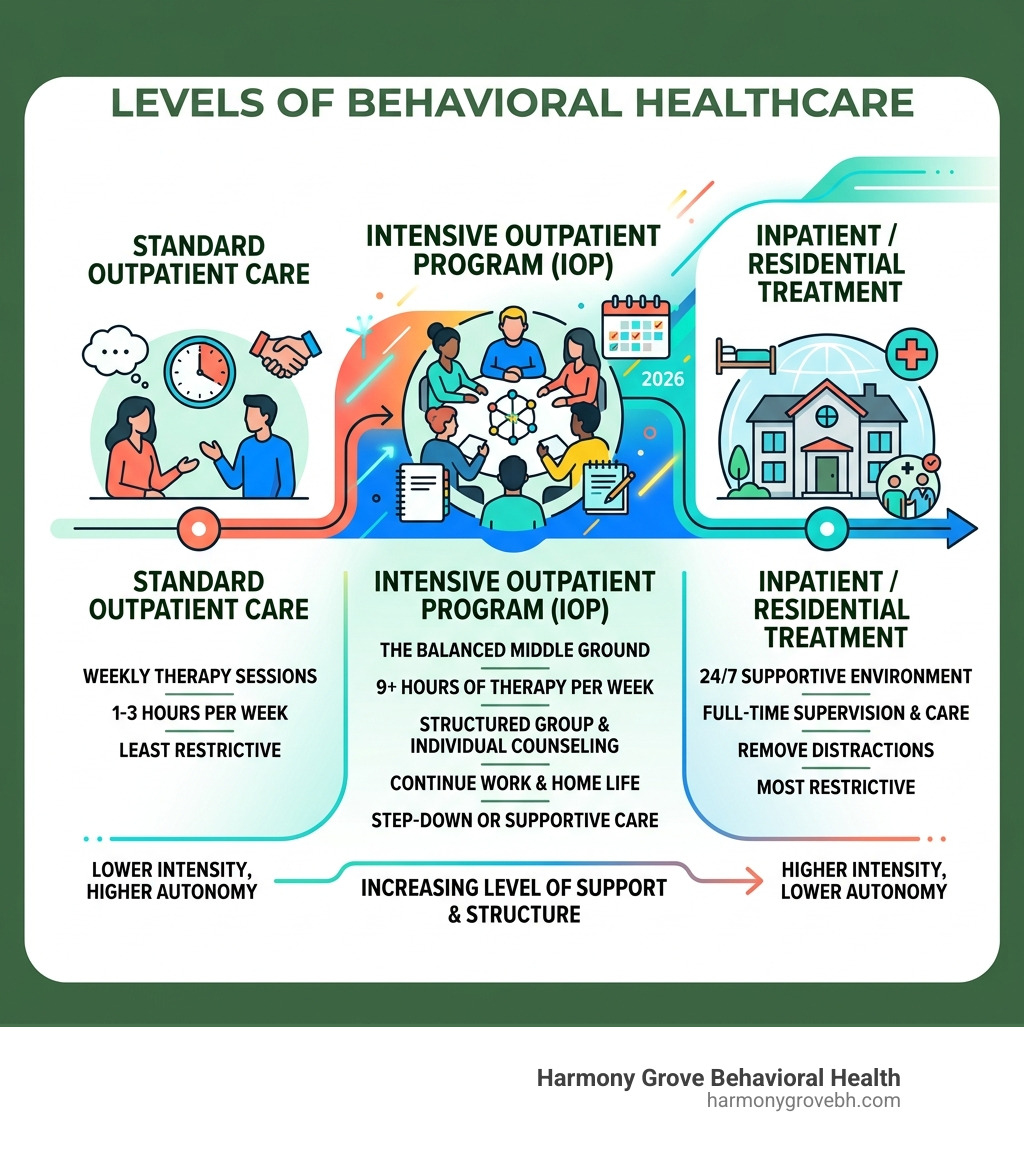
Comparing Treatment Levels: Inpatient vs. IOP vs. Standard Care
Understanding where an intensive outpatient program fits into the recovery journey is essential for making an informed choice. Think of it as a spectrum of care where the intensity of support matches the severity of the symptoms.
| Treatment Level | Time Commitment | Living Situation | Best For |
|---|---|---|---|
| Inpatient / Residential | 24/7 Monitoring | On-site Facility | Acute crisis, detox, severe addiction |
| Partial Hospitalization (PHP) | 20–30 hours/week | Home or Sober Living | High-intensity needs without 24/7 risk |
| IOP | 9–19 hours/week | Home or Sober Living | Moderate symptoms, step-down from inpatient |
| Standard Outpatient | 1–3 hours/week | Home | Maintenance, mild symptoms, long-term support |
The Role of IOP in the Continuum
For many, an IOP in Houston serves as a vital “step-down” from more intensive care. If you have recently completed a residential stay or a detox program, jumping straight back into “normal life” without support can be a recipe for relapse. The IOP acts as a transitional phase, allowing you to practice your new coping skills in the real world while still having several hours of professional support each week.
Conversely, it can be a “step-up” for someone whose symptoms are worsening despite attending weekly therapy. It offers that extra layer of accountability and clinical intervention before a situation reaches a crisis point.
Balancing Independence and Cost
One of the most practical benefits of this middle ground is the cost-effectiveness. Because there is no room and board involved, an intensive outpatient program often costs significantly less than residential treatment—sometimes as much as 50% less. Furthermore, because you are living at home, you don’t have to take a total leave of absence from your job, which preserves your income and professional standing while you heal.
Typical Schedule and Structure of an IOP
One of the most common questions we hear is, “How do I actually fit this into my life?” The beauty of the intensive outpatient program is its inherent flexibility. While the program is rigorous, it is built to accommodate the realities of being an adult with responsibilities.
The Weekly Rhythm
A typical Houston IOP Program usually runs for 3 to 5 days per week. Each session typically lasts about 3 hours. This allows us to dive deep into therapeutic work without the “exhaustion factor” that can come from 8-hour days of processing.
To help you maintain your work-life balance, we often offer different scheduling tracks:
- Morning Options: Ideal for those who work evening shifts or parents who need to be available when kids get home from school.
- Evening Flexibility: Perfect for the “9-to-5” professional who needs to maintain their career while receiving treatment after hours.
Duration and Progression
Most participants remain in an IOP for an average of 8 to 12 weeks. This timeframe isn’t arbitrary; research shows that staying engaged in treatment for approximately 90 days significantly improves long-term abstinence and mental health stability.
As you progress and meet your clinical milestones, the frequency of your sessions may decrease. You might start at 5 days a week and eventually “step down” to 3 days a week as you become more confident in your recovery skills and family obligations become easier to manage.
Evidence-Based Therapies and Holistic Services
An intensive outpatient program isn’t just about “talking through your feelings.” It is a clinical environment where we use specific, scientifically-backed tools to help you rewire your thought patterns and behaviors. At Harmony Grove Behavioral Health, we believe in treating the whole person, not just the diagnosis.
Clinical Foundations
The core of our IOP Houston involves several key modalities:
- Cognitive Behavioral Therapy (CBT): This helps you identify and challenge the negative thought patterns that lead to self-destructive behaviors.
- Dialectical Behavior Therapy (DBT): Excellent for emotional regulation, distress tolerance, and improving interpersonal relationships.
- Group Therapy: This is often the “secret sauce” of an IOP. Connecting with peers who are facing similar struggles reduces the isolation and shame that often accompany addiction and mental illness.
- Individual Counseling: One-on-one time with a primary therapist to dig deeper into personal history and specific triggers.
The Holistic and Trauma-Informed Approach
We know that recovery isn’t just about stopping a behavior; it’s about healing the underlying wounds. Our trauma-informed care ensures that we aren’t just asking “What is wrong with you?” but rather “What happened to you?”
To support this, we integrate various services into our programming:
- Family Therapy: Addiction and mental health issues affect the whole family. We provide a space for healing relationships and improving communication.
- Relapse Prevention: We help you create a “battle plan” for high-stress situations, ensuring you have practical tools to stay sober and stable.
- Psychoeducation: Learning about the neuroscience of recovery—how sleep, nutrition, and stress affect your brain—empowers you to take control of your health.
By combining these evidence-based practices with holistic support, we ensure that you aren’t just surviving, but thriving.
Frequently Asked Questions
Who is a candidate for an intensive outpatient program?
The intensive outpatient program is a versatile tool, but it isn’t the right fit for everyone. Generally, the best candidates are those who:
- Have completed detox: If you are at risk for dangerous withdrawal symptoms, you must complete a medical detox before starting an IOP.
- Have stable housing: Because you live at home, having a safe, supportive, and drug-free environment is crucial for success.
- Have mild-to-moderate symptoms: If you are in an acute psychiatric crisis or require 24/7 medical supervision, inpatient care is a better starting point.
- Are busy professionals or parents: We frequently work with professional athletes, executives, and stay-at-home parents who simply cannot leave their lives for 30 days but desperately need high-level support.
What results can I expect from an intensive outpatient program?
Research into the effectiveness of the intensive outpatient program model is very encouraging. Studies have shown that participants who complete an IOP often see:
- High Abstinence Rates: Some studies report up to a 50-70% abstinence rate at the six-month follow-up mark for substance use.
- Symptom Reduction: Significant decreases in depressive and anxious symptoms.
- Improved Quality of Life: Better engagement in daily life, improved family relationships, and higher life satisfaction.
When you join an Intensive Outpatient Program Houston, you are investing in long-term recovery. You will walk away with a robust set of coping skills and a community of social support that you can rely on long after the program ends.
Is virtual treatment available for an IOP?
Yes! The rise of telehealth has made the Houston Intensive Outpatient Program more accessible than ever. Virtual IOPs (sometimes called VITPs) offer the same 9+ hours of weekly programming and the same evidence-based curriculum, but delivered via secure video sessions.
This is a game-changer for:
- Rural Accessibility: Individuals who live far from a physical treatment center.
- Busy Schedules: People who may have transportation issues or childcare constraints.
- Hybrid Models: Some programs allow you to mix in-person and remote sessions to fit your specific needs.
Conclusion
Recovery shouldn’t feel like a choice between “nothing” and “everything.” At Harmony Grove Behavioral Health, we provide that essential middle ground. Our intensive outpatient program in Houston, Texas, is built on a foundation of holistic, community-focused care.
We don’t just treat symptoms; we support people. Through our evidence-based practices, trauma-informed programming, and commitment to lifelong aftercare, we help our neighbors in Houston find their way back to a life of purpose and joy. If you are ready to find your balance and take the next step in your healing journey, an Intensive Outpatient Program might be exactly the support you’ve been looking for.
Whether you are stepping down from a higher level of care or stepping up to get the help you need before things get worse, we are here to walk that path with you. Your recovery is a journey, and we are honored to be a part of it.