

Trauma Is More Common Than You Think — And So Is the Better Way to Treat It
Trauma informed practices examples are real-world methods that help schools, clinics, social workers, and organizations support people who have experienced trauma — without making things worse.
Here are the most common examples, at a glance:
| Setting | Example Practices |
|---|---|
| Schools | Chill zones, restorative discipline, trigger awareness, positive feedback |
| Social Work | Paced sharing, partnership approach, client empowerment, choice-based care |
| Healthcare | Soft lighting, trauma screening at intake, avoiding restraint, safe physical spaces |
| Organizations | Staff training, self-care programs, trauma-informed policy, readiness assessments |
Trauma is not rare. Around 70% of adults in the United States have experienced at least one traumatic event in their lifetime. And 64% of adults report at least one Adverse Childhood Experience (ACE) before age 18 — with 17% experiencing four or more.
Those numbers matter — because unaddressed trauma shows up everywhere. In classrooms. In doctor’s offices. In treatment centers. In the workplace.
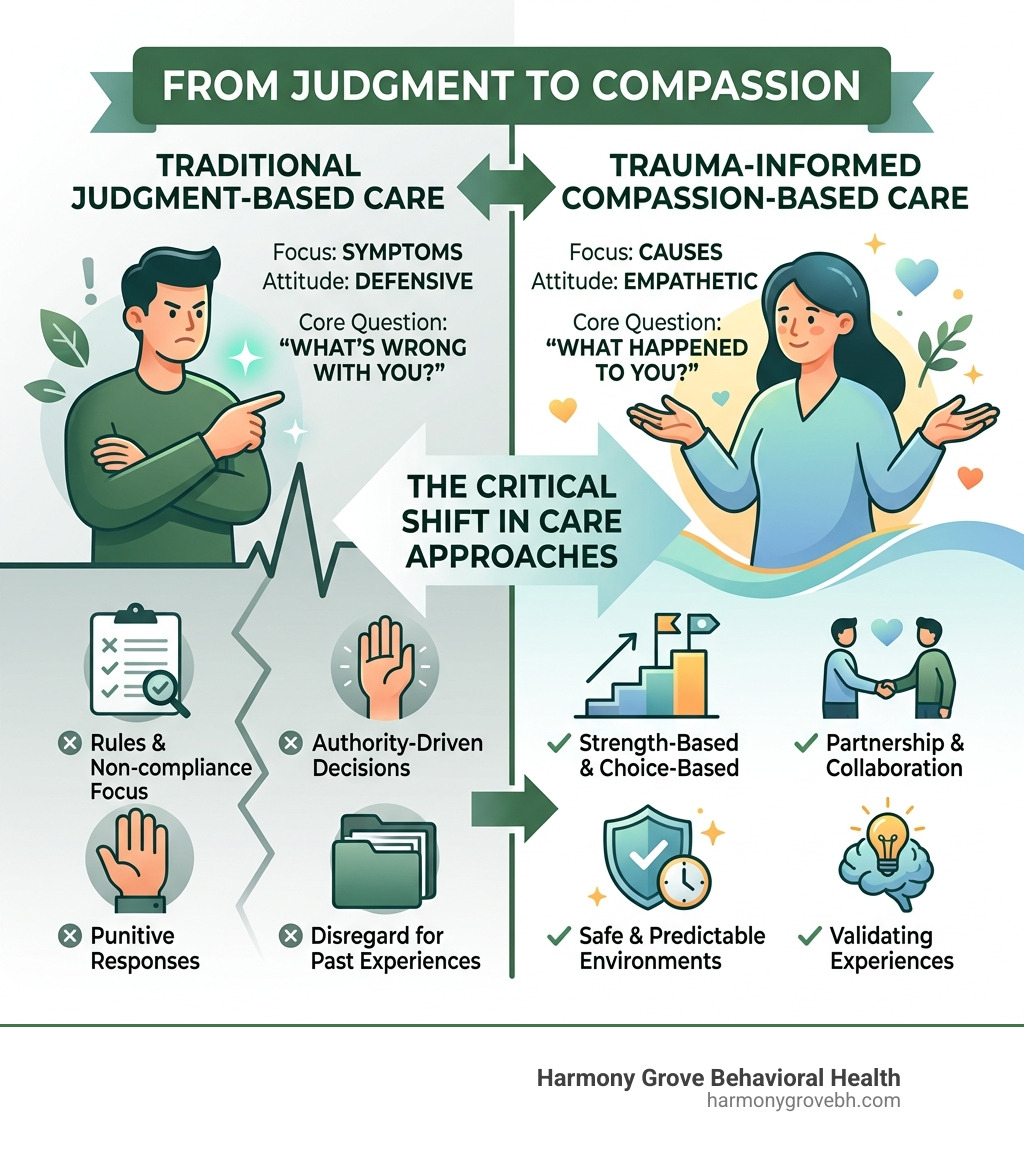
Traditional care often asks, “What’s wrong with you?” Trauma-informed care asks instead, “What happened to you?” That single shift changes everything — from how a counselor opens a session, to how a school handles a student outburst, to how a healthcare provider designs a waiting room.
This article walks through concrete, real-world examples of trauma-informed practices across multiple settings, so you can see exactly what this approach looks like in action.
The 6 Core Principles of Trauma-Informed Care
Before we dive into specific trauma informed practices examples, we need to understand the “North Star” that guides them. These six principles, established by SAMHSA, ensure that any intervention actually helps rather than hurts.
- Safety: This is the foundation. If a person doesn’t feel physically and emotionally safe, their brain stays in “survival mode,” making healing impossible.
- Trustworthiness and Transparency: Organizations must be clear about how decisions are made. Consistency is key to building rapport over time.
- Peer Support: Connecting with others who have “been there” reduces isolation and builds a sense of community.
- Collaboration and Mutuality: This is about “doing with” rather than “doing to.” It levels the power dynamic between the provider and the client.
- Empowerment, Voice, and Choice: We focus on a person’s strengths. We give them options so they can regain the sense of control that trauma often steals.
- Cultural, Historical, and Gender Issues: We must move past stereotypes and recognize how a person’s background influences their experience of trauma.
By following this Six Principles of Trauma-Informed Care Guide, we create environments where people can move from “surviving” to “thriving.” At Harmony Grove Behavioral Health, we integrate these principles into all our mental health services to ensure every individual feels seen and respected.
Real-World Trauma Informed Practices Examples in Schools
Schools are often the front lines of trauma support. Research shows that students with three or more ACEs are six times more likely to have behavioral issues and three times more likely to experience academic failure. They are also five times more likely to struggle with attendance.
When a student is “acting out,” a trauma-informed educator doesn’t see a “bad kid.” They see a nervous system that is overwhelmed.
Trauma Informed Practices Examples for Educators
- The “Chill Zone”: Instead of a “time-out” corner which can feel like a punishment, many classrooms now feature a “safe space” or “chill zone.” This is a quiet area with sensory tools, journals, or soft seating where a student can go to self-regulate before returning to the lesson.
- Restorative Practices: Instead of immediate suspension or detention, schools use restorative circles. This allows students to discuss the harm caused by their actions and work on a “clean slate” for the next day.
- Predictable Routines: Trauma thrives on chaos. Educators can build safety by posting daily schedules and giving “five-minute warnings” before transitions.
- Trigger Awareness: Teachers learn to recognize “red flags”—like a student putting their head down or becoming suddenly aggressive—as potential trauma responses to a specific loud noise, anniversary, or topic.
- Relationship Building: Simple actions, like greeting every student by name at the door or using positive feedback to build self-efficacy, create a protective “buffer” against stress.
For students struggling with high levels of stress, specialized anxiety treatment can provide the extra layer of support needed to succeed in the classroom.

Clinical and Social Work Applications
In clinical settings, the goal is to avoid retraumatization. This happens when a treatment environment inadvertently mimics the original trauma—for example, a cold, clinical room with bright lights that feels like a place where a client was once hurt.
Trauma Informed Practices Examples for Social Work
Social workers often deal with complex family dynamics and abuse survivors. Here is how they apply trauma-informed care:
- Paced Sharing: Instead of forcing a client to “tell their whole story” during the first intake (which can be incredibly overwhelming), social workers allow the client to share at their own pace.
- The Partnership Approach: The social worker frames the relationship as a collaboration. For an overwhelmed parent, this might look like saying, “We are going to figure out these school evaluations together,” rather than “Here is what you must do.”
- Validating Losses: For a client who has experienced a major life change, such as a cancer diagnosis or a job loss, the social worker focuses on validating that grief before jumping into “problem-solving.”
- Choice in Environment: Giving a client the choice of where to sit, or even offering “one-on-one” sessions instead of a group if they feel unsafe, empowers them.
For those dealing with both mental health challenges and substance use, we provide specialized dual diagnosis treatment that addresses the trauma underlying both conditions.
Clinical Trauma Informed Practices Examples in Healthcare
Healthcare providers can significantly improve patient engagement and treatment adherence by making small environmental and procedural changes:
- Physical Environment: Using soft lighting, natural-themed art, and comfortable seating in waiting rooms to reduce “white coat hypertension” and anxiety.
- Universal Screening: Using tools like the Brief Trauma Questionnaire during intake to understand a patient’s history without making them relive every detail.
- Eliminating Restraint and Seclusion: Modern trauma-informed healthcare seeks to eliminate coercive practices. Seclusion and restraint are now recognized as deeply traumatizing and are only used as an absolute last resort, with a focus on de-escalation instead.
- Addressing Social Determinants of Health (SDOH): Recognizing that a patient’s lack of transportation or housing is a stressor that impacts their physical health.
These clinical modalities are essential for patients who may have previously avoided the doctor due to medical mistrust or past negative experiences, particularly those seeking depression treatment.
Building a Trauma-Informed Organization
A trauma-informed approach isn’t just for the person in the counselor’s chair; it’s for the entire organization. This includes the front desk staff, the leadership, and the billing department.
- Staff Training and Wellness: You cannot pour from an empty cup. Sustaining a trauma-informed culture requires addressing secondary traumatic stress and burnout. Organizations should provide dedicated time and space for staff self-care.
- Readiness Assessments: Before implementing new policies, leadership should assess the organization’s current capacity. Are the policies supportive or punitive?
- Governance and Leadership: Buy-in must come from the top. Leaders should model transparency and humility, admitting when they don’t have all the answers and seeking input from staff and clients alike.
- Physical Safety: Ensuring that hallways are well-lit, exits are clearly marked, and there are private spaces for sensitive conversations.
Investing in mental health rehab for staff and creating a culture of mutual support ensures that the organization remains a “healing space” for everyone involved.
Frequently Asked Questions about Trauma-Informed Care
What is the main goal of trauma-informed care?
The main goal is to provide a environment that realizes the widespread impact of trauma, recognizes the signs and symptoms in clients and staff, responds by fully integrating this knowledge into policies, and actively resists retraumatization. It’s about creating safety so that recovery can actually begin.
How does trauma-informed care differ from traditional care?
Traditional care often focuses on “compliance” and “symptom management,” asking “What is wrong with you?” Trauma-informed care focuses on “collaboration” and “empowerment,” asking “What happened to you?” It shifts the power dynamic from “authority figure vs. patient” to “partner vs. partner.” This is especially vital for treating co-occurring disorders, where trauma and addiction are often intertwined.
Why is staff self-care important in trauma-informed practices?
Working with trauma survivors can lead to compassion fatigue or secondary traumatic stress. If staff members are burnt out, they cannot provide the calm, regulated presence that clients need. Staff wellness is not a “luxury”—it is a core requirement for a sustainable, trauma-informed organization.
Conclusion
At Harmony Grove Behavioral Health in Houston, Texas, we believe that understanding trauma informed practices examples is the first step toward creating a more compassionate world. Whether in a school, a hospital, or an outpatient treatment center, these practices save lives by making people feel safe enough to heal.
The connection between trauma and other health issues is undeniable. For instance, 47% of individuals with PTSD also struggle with a comorbid substance use disorder. By addressing the trauma, we address the root of the struggle.
| Benefit | For Patients/Students | For Staff/Organizations |
|---|---|---|
| Safety | Reduced anxiety and triggers | Lower rates of workplace injury |
| Engagement | Better treatment adherence | Reduced burnout and turnover |
| Outcomes | Improved long-term recovery | Stronger community reputation |
| Culture | Feeling seen and heard | Higher morale and collaboration |
If you or a loved one are ready to move past the weight of the past, we are here to help. Our holistic, community-focused care is designed to meet you exactly where you are. Start your recovery journey with PTSD treatment today and discover the difference that trauma-informed care can make.