
What Trauma-Informed Care Really Means (And Why It Changes Everything)
Trauma-informed care is a framework that shifts how healthcare providers and organizations understand and respond to the people they serve — moving the question from “What’s wrong with you?” to “What happened to you?”
Here’s a quick summary of what it involves:
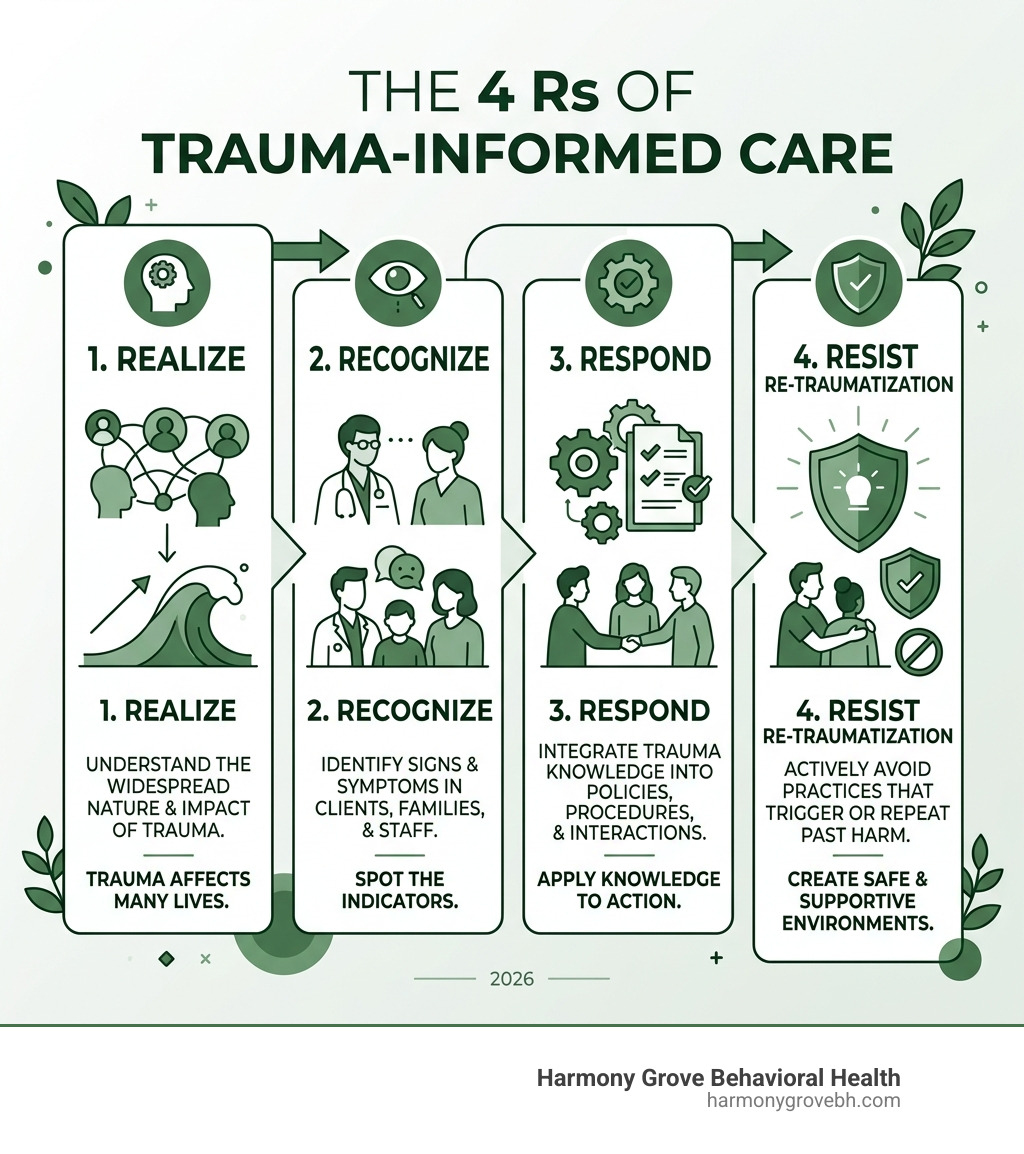
- Realize — Understand how widespread trauma is and how it affects people’s lives
- Realize — Understand how widespread trauma is and how it affects people’s lives
- Recognize — Identify the signs and symptoms of trauma in patients, families, and staff
- Respond — Integrate that knowledge into every policy, procedure, and interaction
- Resist re-traumatization — Actively avoid practices that could trigger or repeat past harm
If you’ve ever felt like a healthcare provider wasn’t seeing the full picture of your life — just treating symptoms without asking what caused them — that’s exactly the gap trauma-informed care is designed to close.
Trauma is far more common than most people realize. Research from the National Comorbidity Study found that 61% of men and 51% of women have experienced at least one traumatic event in their lifetime. For people struggling with addiction or mental health challenges, that number is even higher — more than half of women entering substance use treatment report one or more lifetime traumas.
Yet traditional care models often treat these issues in isolation, missing the deeper connection between past experiences and present struggles.
Trauma-informed care changes that. It’s not just a clinical technique — it’s a whole-organization commitment to creating environments where people feel safe, respected, and empowered to heal.
Defining Trauma-Informed Care and Its Core Principles

At its heart, trauma-informed care (TIC) is an organizational change process. It isn’t a single “treatment” you receive during a 45-minute session; it is a philosophy that colors every interaction, from the moment you call for an appointment to the way the clinic is lit and decorated.
According to SAMHSA’s Concept of Trauma and Guidance for a Trauma-Informed Approach, a trauma-informed approach is built on a “four-fold” realization. We must realize the pervasive nature of trauma, recognize how it manifests in behavior, respond with trauma-sensitive policies, and—most importantly—resist re-traumatization.
Think of it like “universal precautions” in medicine. Just as doctors wear gloves to protect everyone from potential pathogens without knowing who is sick, we treat every individual with the assumption that they may have a history of trauma. This ensures that no one is accidentally harmed by the very systems meant to help them.
| Feature | Traditional Care | Trauma-Informed Care |
|---|---|---|
| Primary Question | What is wrong with you? | What has happened to you? |
| View of Symptoms | Pathological/Signs of illness | Adaptive/Resilient survival strategies |
| Provider Role | Expert who dictates treatment | Partner who collaborates on healing |
| Goal | Symptom reduction | Empowerment and recovery |
| Focus | Individual diagnosis | Context of the person’s life and environment |
This paradigm shift is vital because many people who have experienced trauma don’t naturally connect their past experiences with their current health or behavioral issues. They may feel they “should be over it” or simply avoid the topic because it’s too painful. When we use a trauma-informed lens, we help bridge that gap.
The Six Guiding Principles of Trauma-Informed Care
To make this concept practical, SAMHSA identified six key principles that guide every trauma-informed organization. These are the “north stars” we follow here at Harmony Grove Behavioral Health.
- Safety: This includes both physical safety (a well-lit, clean facility) and psychological safety (feeling like you won’t be judged or shamed).
- Trustworthiness and Transparency: Decisions are made with you, not for you. Operations and clinical decisions are explained clearly to build a foundation of trust.
- Peer Support: Connecting with others who have “been there” is a powerful tool for healing. It reduces isolation and proves that recovery is possible.
- Collaboration and Mutuality: We believe in leveling the power dynamic. You are the expert on your own life, and we are here to provide the clinical tools to support your journey.
- Empowerment, Voice, and Choice: Trauma often involves a loss of control. Healing involves getting that control back. We prioritize your right to make choices about your care.
- Cultural, Historical, and Gender Issues: We recognize that trauma doesn’t happen in a vacuum. We must be responsive to the unique experiences of different racial, ethnic, and gender groups, acknowledging historical traumas that may impact how someone views the healthcare system.
To dive deeper into how these principles are applied in a clinical setting, check out our guide on How to Master Trauma-Informed Care Best Practices.
Recognizing the Impact of Adverse Childhood Experiences (ACEs)
One of the most significant breakthroughs in understanding trauma came from the study of Adverse Childhood Experiences, or ACEs. These are potentially traumatic events that occur before age 18, such as abuse, neglect, or witnessing violence in the home.
The statistics are eye-opening: Over 75% of high school students report having experienced at least one ACE. When a child is exposed to chronic, “toxic stress” without the buffer of a supportive relationship, it can literally change the architecture of their developing brain. This can lead to long-term health problems, including increased risks for heart disease, depression, and substance use disorders later in life.
However, it is important to understand what an ACE score is—and what it isn’t. An ACE score is a tally of different types of abuse, neglect, and other hallmarks of a rough childhood. While it’s a helpful research tool, the American Academy of Pediatrics (AAP) notes that an ACE score shouldn’t be used as a definitive clinical screening tool. Why? Because it doesn’t account for “protective factors”—the safe, stable, and nurturing relationships that can help a child develop resilience despite their trauma.
We focus on “relational healthcare,” which emphasizes that healing happens through safe relationships. As noted by The National Child Traumatic Stress Network, recognizing these experiences helps us move toward a strengths-based framework that highlights a person’s resilience rather than just their “pathology.”
Why Trauma-Informed Care is Essential in Behavioral Health
In behavioral health, trauma is the rule, not the exception. Whether someone is seeking help for Mental Health concerns or Co-Occurring Disorders, a history of trauma is frequently the underlying current driving their symptoms.
There is a “bidirectional” relationship between trauma and substance use. Trauma increases the risk of developing a substance use disorder as a way to self-medicate painful memories or “numb out” from hyper-vigilance. Conversely, the lifestyle often associated with active addiction can expose individuals to further traumatic events, creating a vicious cycle.
If we only treat the addiction without addressing the trauma, the “why” behind the use remains. This is why PTSD Treatment must be integrated into the recovery process. By treating the whole person, we increase the chances of long-term, sustainable recovery.
Avoiding Re-traumatization in Clinical Settings
One of the most tragic ironies in healthcare is that the systems designed to help can sometimes cause more harm. This is known as re-traumatization. It happens when a situation, interaction, or environment replicates the original trauma, triggering a “fight, flight, or freeze” response.
Common triggers in traditional settings might include:
- Seclusion and Restraint: Once thought to be therapeutic, these practices are now recognized as deeply traumatizing for both the patient and the staff. Research shows that staff injury rates are actually higher in facilities that use these methods.
- Power Dynamics: Feeling forced to do something or having no choice in treatment can mirror the powerlessness felt during trauma.
- Sensory Triggers: Loud noises, bright fluorescent lights, or even specific smells in a clinical setting can act as “cues” for past trauma.
- Forced Disclosure: Being pushed to tell a “trauma story” before a person feels safe or ready can be incredibly harmful.
As highlighted by the National Center for PTSD, trauma-informed care prioritizes patient autonomy. We ensure that our clinical orientation is one of invitation and partnership, not coercion. By maintaining strict safety protocols and a calm environment, we create a space where healing can actually begin.
Implementing a Trauma-Informed Approach in Organizations
Becoming a trauma-informed organization isn’t like flipping a switch. It is a journey that typically takes three to five years to fully embed into the culture. It requires “buy-in” from the very top—leadership must be as committed to these values as the frontline clinicians.
One of the most overlooked aspects of TIC is the wellness of the staff. Healthcare providers, especially those in Behavioral Health Houston, are at high risk for secondary traumatic stress. This is the emotional “wear and tear” that comes from hearing traumatic stories day after day.
If our staff doesn’t feel safe, supported, and empowered, they cannot effectively provide that same environment for our clients. We utilize various Clinical Modalities to support both our team and our clients, ensuring that self-care is a requirement, not an afterthought. This is especially critical when providing Dual Diagnosis Treatment in Houston, where the complexity of cases can be high.
Steps to Becoming a Trauma-Informed Care Provider
For an organization to truly say they are trauma-informed, they must take actionable steps across every level of their operation:
- Staff Training: This isn’t just for therapists. Front-desk staff, security personnel, and billing departments all need training to recognize signs of distress and respond with empathy.
- Policy Review: Every policy—from how we handle missed appointments to how we conduct intakes—should be reviewed through a trauma-aware lens. Does this policy empower the client, or does it punish them?
- Physical Environment: Is the waiting room calming? Are there clear signs so people don’t feel lost or confused? We aim to create a space that feels like a sanctuary, not a cold institution.
- Client Voice: We actively seek feedback from the people we serve. Their perspective is the most valuable tool we have for improving our Mental Health Services Houston.
- Evaluation: We don’t just “hope” we are being trauma-informed; we measure it. We look at patient engagement, staff turnover, and clinical outcomes to ensure our approach is working.
Frequently Asked Questions about Trauma-Informed Care
What is the difference between trauma-specific treatment and trauma-informed care?
This is a great question! Trauma-informed care is the environment and approach used by the entire organization. It’s the “how” of service delivery. Trauma-specific treatments are the actual clinical interventions used to treat the symptoms of trauma, such as EMDR, Cognitive Processing Therapy (CPT), or Prolonged Exposure. You can have a trauma-informed clinic that doesn’t offer a specific trauma therapy, but you can’t effectively provide trauma therapy in a clinic that isn’t trauma-informed.
Can ACE scores be used for clinical screening or diagnosis?
The short answer is no. While knowing a person’s ACE score can provide context, it is not a diagnostic tool. Two people with the same ACE score can have very different outcomes based on the “protective factors” they had in their lives. We use ACE research to understand the potential impact of childhood stress, but we treat every individual based on their unique strengths and current needs.
How does trauma-informed care benefit healthcare providers and staff?
It’s a win-win. When an organization is trauma-informed, staff feel more supported and empowered. This leads to reduced burnout, lower turnover rates, and a more positive workplace culture. When the staff is healthy and happy, the quality of care for the patients naturally improves.
Conclusion
At Harmony Grove Behavioral Health, we believe that your past does not have to define your future. By embracing a trauma-informed approach, we provide a community-focused, holistic environment where you can feel safe enough to do the hard work of recovery.
Whether you are seeking help for addiction, mental health, or both, our Houston-based team is here to walk alongside you. We use evidence-based practices and a deep understanding of the human spirit to help you move from surviving to thriving.
The journey of a thousand miles begins with a single, safe step. If you’re ready to explore a different kind of healing—one that sees you as a whole person with a story worth hearing—we are here for you.
Start your healing journey with specialized PTSD treatment today. You don’t have to carry the weight of “what happened” all by yourself.