

When Worry and Sadness Won’t Let Go: What You Need to Know About Treatment for Depression and Anxiety
Treatment for depression and anxiety most often combines psychotherapy, medication, and lifestyle changes — and the good news is that it works.
Quick answer: the most effective treatments include:
- Psychotherapy (especially Cognitive Behavioral Therapy and Interpersonal Therapy)
- Antidepressant medications (SSRIs and SNRIs are the most commonly prescribed)
- Lifestyle changes (exercise, sleep, nutrition, stress management)
- Brain stimulation therapies (TMS or ECT for severe or treatment-resistant cases)
- Combined approaches (therapy + medication together outperforms either alone)
About 80-90% of people with depression who seek treatment respond well — often within 4-6 weeks of starting the right plan.
Here’s the hard truth: depression and anxiety rarely travel alone.
Between 60-90% of people with depression also experience moderate to severe anxiety. That’s not a coincidence — these two conditions share overlapping biology, symptoms, and triggers. Together, they create what feels like a two-headed monster: one pulling you into hopelessness, the other pushing you into constant fear.
For many people — especially those juggling demanding careers, relationships, and the added weight of substance use — this combination can feel completely paralyzing.
The symptoms aren’t a character flaw. They’re a medical reality. And they’re treatable.
Roughly 1 in 6 adults will experience depression at some point in their lifetime, and anxiety disorders are the most common mental health condition in the U.S. When they occur together, the condition is sometimes called anxious depression — affecting an estimated 10-16 million Americans every year.
Understanding what’s happening in your brain — and knowing which treatments actually work — is the first step toward getting your life back.
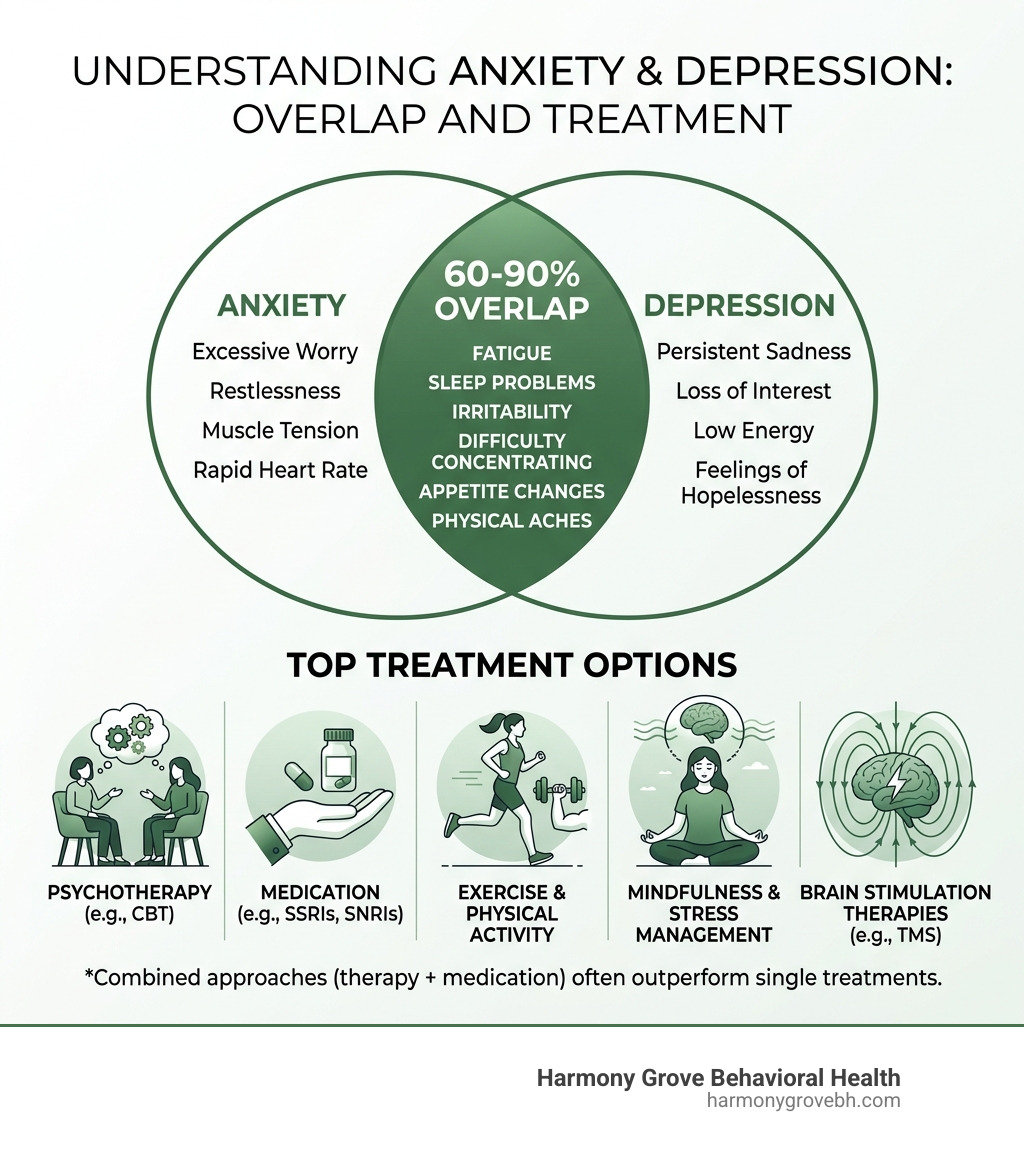
Understanding the Link: Symptoms and Diagnosis of Co-occurring Disorders

When we talk about the “two-headed monster,” we’re describing a situation where the symptoms of anxiety and depression feed into one another. It’s a bit like a merry-go-round you never asked to ride. Depression often brings a sense of lethargy, hopelessness, and a heavy “fog” over your daily life. Anxiety, on the other hand, brings physical hyperarousal—your heart races, your palms sweat, and your mind spins with “what if” scenarios.
At Harmony Grove Behavioral Health, we often see that these conditions share a common set of symptoms that make them difficult to untangle. Both can cause severe sleep disturbances, irritability, and difficulty concentrating. You might feel exhausted from the depression but too “wired” from the anxiety to actually rest.
Comparing Symptoms: Anxiety vs. Depression
| Feature | Anxiety | Depression |
|---|---|---|
| Primary Mood | Excessive worry, fear, or tension | Persistent sadness, hopelessness, or emptiness |
| Physical State | Hyperarousal, racing heart, shakiness | Lethargy, fatigue, slowed movement |
| Focus | Future-oriented (fearing what might happen) | Past or present-oriented (regret or current despair) |
| Sleep | Difficulty falling asleep due to racing thoughts | Waking too early or sleeping too much |
| Appetite | Often “nervous” stomach or loss of appetite | Significant weight loss or emotional overeating |
Diagnosing these conditions requires a professional look at the big picture. Doctors typically use the DSM-5 (the “gold standard” manual for mental health) to see if you meet specific criteria. For example, Major depressive disorder symptoms and causes often include a loss of interest in activities you once loved, lasting at least two weeks. When anxiety is added to the mix, it’s often classified as “anxious distress” within the depression diagnosis.
If you’re in the Houston area and feeling overwhelmed, our Mental Health Services Houston team is trained to help you navigate this complex diagnostic process to ensure you get the right care from the start.
The Prevalence of Anxious Depression
It is surprisingly common to struggle with both. Statistics show that nearly 7% of U.S. adults have depression every year, and more than 16% will experience it at some point in their lives. However, when we look at “anxious depression”—where Major Depressive Disorder meets Generalized Anxiety Disorder—the numbers are even more striking.
With 10 to 16 million Americans affected annually, you are certainly not alone. This combination is often more difficult to treat than depression alone because the anxiety can make it harder to stick to a routine or stay motivated for therapy. Understanding your specific Mental Health profile is the first step toward a tailored recovery plan.
How Professionals Diagnose Combined Conditions
When you visit a professional, the process is much more than just a conversation. It’s a comprehensive check-up for your mind. A typical evaluation includes:
- Psychiatric Evaluation: Discussing your thoughts, feelings, and behavior patterns.
- Lab Tests: Sometimes, physical issues like thyroid problems or vitamin deficiencies can mimic depression.
- Differential Diagnosis: Ensuring that the symptoms aren’t caused by something else, like Bipolar Disorder. This is critical because certain treatments for depression can actually trigger a manic episode in someone with Bipolar Disorder.
- Substance Screening: Checking if alcohol or drugs are being used to “self-medicate.”
Our experts at Behavioral Health Houston 621029 use these tools to create a roadmap for your treatment, ensuring no stone is left unturned.
Evidence-Based Treatment for Depression and Anxiety
The most important thing to remember is that treatment for depression and anxiety is highly effective. Approximately 80% to 90% of people who seek professional help eventually respond well. The key is finding the right combination of tools. Think of it like a toolbox: you might need a hammer (medication) for the heavy lifting and a screwdriver (therapy) for the fine-tuning.
Effective care usually involves a “multi-modal” approach. This means we don’t just look at one part of your life; we look at your thoughts, your biology, and your habits. You can find more detailed Depression Treatments for Adults through the APA guidelines, which emphasize that a combination of therapy and medication often yields the best results. For those specifically looking for Anxiety Treatment in Houston Texas, our local programs focus on these evidence-based foundations.
First-Line Psychotherapy: CBT and IPT as a Treatment for Depression and Anxiety
Psychotherapy, or “talk therapy,” is much more than just venting. It’s about learning new skills to rewire how your brain processes the world.
- Cognitive Behavioral Therapy (CBT): This is the “gold standard” for both conditions. CBT helps you identify negative thought patterns (like “I’m a failure” or “Something terrible is going to happen”) and replace them with more realistic, helpful thoughts. It’s practical and goal-oriented, usually lasting 8 to 20 sessions.
- Interpersonal Therapy (IPT): This focuses on your relationships. Often, depression and anxiety are triggered or worsened by conflicts with loved ones, grief, or big life changes (like moving to a new city or starting a new job). IPT helps you improve your communication and social support.
- Behavioral Activation: This is a core part of depression treatment. It involves “doing” even when you don’t “feel” like it. By re-engaging in pleasurable activities, you can slowly break the cycle of lethargy.
If you’re ready to start this journey, our Depression Treatment in Houston TX offers specialized therapy tracks designed to help you build these long-term coping skills.
Pharmacotherapy: Medications as a Treatment for Depression and Anxiety
For many, medication provides the “floor” they need to stand on so they can do the work of therapy. Antidepressants work by balancing neurotransmitters—the brain’s chemical messengers—like serotonin, dopamine, and norepinephrine.
- SSRIs (Selective Serotonin Reuptake Inhibitors): These are usually the first choice because they have fewer side effects. Examples include sertraline (Zoloft) and fluoxetine (Prozac).
- SNRIs (Serotonin-Norepinephrine Reuptake Inhibitors): These are often used when SSRIs aren’t enough, as they target two different chemicals. Examples include duloxetine (Cymbalta) and venlafaxine (Effexor).
- Management: It’s important to know that these aren’t “happy pills.” They take time to work—usually 4 to 6 weeks. Side effects like nausea or dry mouth are common in the first week but usually fade.
At our Mental Health Rehab Houston, we provide close medication management to ensure your dosage is effective and side effects are minimized.
Advanced Interventions for Anxious Depression and Treatment-Resistance
Sometimes, the standard “meds and therapy” approach isn’t quite enough. This is known as treatment-resistant depression. If you’ve tried two or more antidepressants without success, don’t lose heart—there are advanced, FDA-cleared options available.
Research shows that for those with “anxious depression,” specialized interventions can target the specific brain regions responsible for both fear and sadness. You can read more about the Scientific research on initial management of depression for a deeper dive into these protocols. For those needing a higher level of care, Long-term Mental Health Facilities in Houston Texas 621044 offer intensive support for complex cases.
The Role of Brain Stimulation in Treatment for Depression and Anxiety
Brain stimulation therapies might sound like science fiction, but they are evidence-based medical treatments that have helped thousands of people.
- Transcranial Magnetic Stimulation (TMS): This uses magnetic pulses (similar to an MRI) to stimulate nerve cells in the brain. Deep TMS is particularly exciting because it’s the first TMS system FDA-cleared specifically to reduce anxiety symptoms in people with depression. It’s non-invasive, meaning you can drive yourself to and from appointments.
- Electroconvulsive Therapy (ECT): While it has a scary reputation in movies, modern ECT is a safe, highly effective procedure performed under general anesthesia. It is often the fastest way to relieve severe depression or suicidal thoughts.
For residents of Houston, our Mental Health Services Houston 621025bc can help determine if these advanced therapies are right for you.
Emerging Therapies and Precision Psychiatry
The future of mental health is moving toward “precision psychiatry”—using biomarkers like EEG signatures to predict which treatment will work for you before you even start it. This eliminates the “trial and error” phase that can be so frustrating.
- Ketamine and Esketamine (Spravato): These are rapid-acting treatments that can improve mood within hours or days, rather than weeks. They work on the glutamate system to promote neuroplasticity—essentially helping your brain “repair” itself.
- Dual Diagnosis: We also recognize that many people use substances to cope with their symptoms. Our Dual Diagnosis Treatment in Houston addresses both the mental health condition and the substance use simultaneously, as treating one without the other often leads to relapse.
Holistic Strategies and Lifestyle Changes for Recovery
While professional help is essential, the things you do every day at home play a massive role in your recovery. We believe in a holistic approach—treating the whole person, not just the diagnosis.
Understanding What is Dual Diagnosis Understanding the Connection Between Mental Health and Addiction helps clarify why lifestyle balance is so vital. When your body is healthy, your mind has a much better chance of staying balanced.
Addressing Substance Use and Smoking Cessation
Here is a statistic that often surprises people: About 3 out of every 10 cigarettes smoked by adults in the U.S. are smoked by people with mental health conditions. Many people smoke or use substances because they feel it helps their anxiety in the short term. However, nicotine and alcohol are actually “chemical stressors” that make anxiety and depression worse over time.
Quitting smoking or reducing substance use is one of the most powerful things you can do for your mental health. At Harmony Grove, we provide Co-occurring Disorders support that is trauma-informed, helping you find healthier ways to cope with stress than reaching for a drink or a cigarette.
Self-Help and Community Support Systems
Recovery doesn’t happen in a vacuum. Community is a powerful medicine.
- Support Groups: Connecting with others who “get it” can reduce the shame and isolation that often come with mental health struggles.
- Mindfulness and Exercise: Regular physical activity releases endorphins—your body’s natural mood lifters. Even a 20-minute walk can make a difference. Mindfulness-based stress reduction (MBSR) helps you stay grounded in the present moment, which is the natural enemy of anxiety.
- Family Involvement: When your loved ones understand what you’re going through, they can become your strongest allies.
Our programs, including PTSD Treatment, often incorporate these community elements to ensure you have a robust support network.
Frequently Asked Questions about Depression and Anxiety
How long does it typically take for treatment to work?
Most people start to see some improvement within 4 to 6 weeks. However, it’s important to stay the course. Antidepressants often take a month to reach full effect, and therapy is a process of building new habits. We usually recommend continuing treatment for at least 6 to 12 months after you start feeling better to prevent the symptoms from returning.
What are the warning signs of suicide risk?
If you or someone you know is talking about feeling like a burden, having no reason to live, or withdrawing from friends and family, seek help immediately. You can call or text 988 anytime to reach the Suicide & Crisis Lifeline. This is a free, confidential resource available 24/7. Never hesitate to go to the nearest emergency room if you are in crisis.
Can lifestyle changes replace professional medical treatment?
For very mild cases, lifestyle changes like improved sleep and exercise might be enough. However, for moderate to severe treatment for depression and anxiety, professional intervention is almost always necessary. Think of it this way: you wouldn’t try to heal a broken leg with just “positive thinking” and a good diet. You’d get a cast. Professional treatment is the “cast” for your mental health.
Conclusion
The road to recovery from the “two-headed monster” of anxiety and depression isn’t always a straight line, but it is a road that leads to a better life. With an 80-90% success rate for those who seek help, the prognosis is incredibly hopeful. Whether it’s through the precision of CBT, the biological support of medication, or the innovative power of Deep TMS, there is a path forward for you.
At Harmony Grove Behavioral Health, we are proud to serve the Houston community from our location at 2855 Mangum Road Suite A350. We provide holistic, trauma-informed outpatient care that doesn’t just treat symptoms—it supports your entire journey toward wellness.
If you’re tired of “muddling along” and are ready to reclaim your peace of mind, reach out to us. Your Mental Health is worth the investment. Let’s start your journey to recovery today.