

Why Addiction Intensive Outpatient Houston Is the Recovery Path Worth Knowing About
If you’re looking for addiction intensive outpatient houston treatment, here’s what you need to know right away:
Top things to know about Houston addiction IOP:
- What it is: A structured treatment program where you attend therapy several hours a day, 3-5 days a week, while living at home
- Who it’s for: Adults with mild-to-moderate substance use disorders, or those stepping down from residential care
- Time commitment: Typically 9-20 hours per week over 8-12 weeks
- What’s included: Group therapy, individual counseling, family therapy, relapse prevention, and often dual diagnosis support
- Cost: Covered by most major insurance plans; sliding scale options may be available
- Key benefit: You keep your job, your routine, and your life — while getting real clinical support
Houston has over 89 IOP treatment centers. That’s a lot of options. And if you’re a working professional juggling career, family, and a substance use struggle, finding the right fit matters more than finding the fastest answer.
The good news? Intensive outpatient care is specifically designed for people like you. It gives you the structure of a clinical program without requiring you to step away from your life completely.
At Harmony Grove Behavioral Health, we believe recovery works best when it fits into your real world — not the other way around.
Defining the Addiction Intensive Outpatient Houston Model
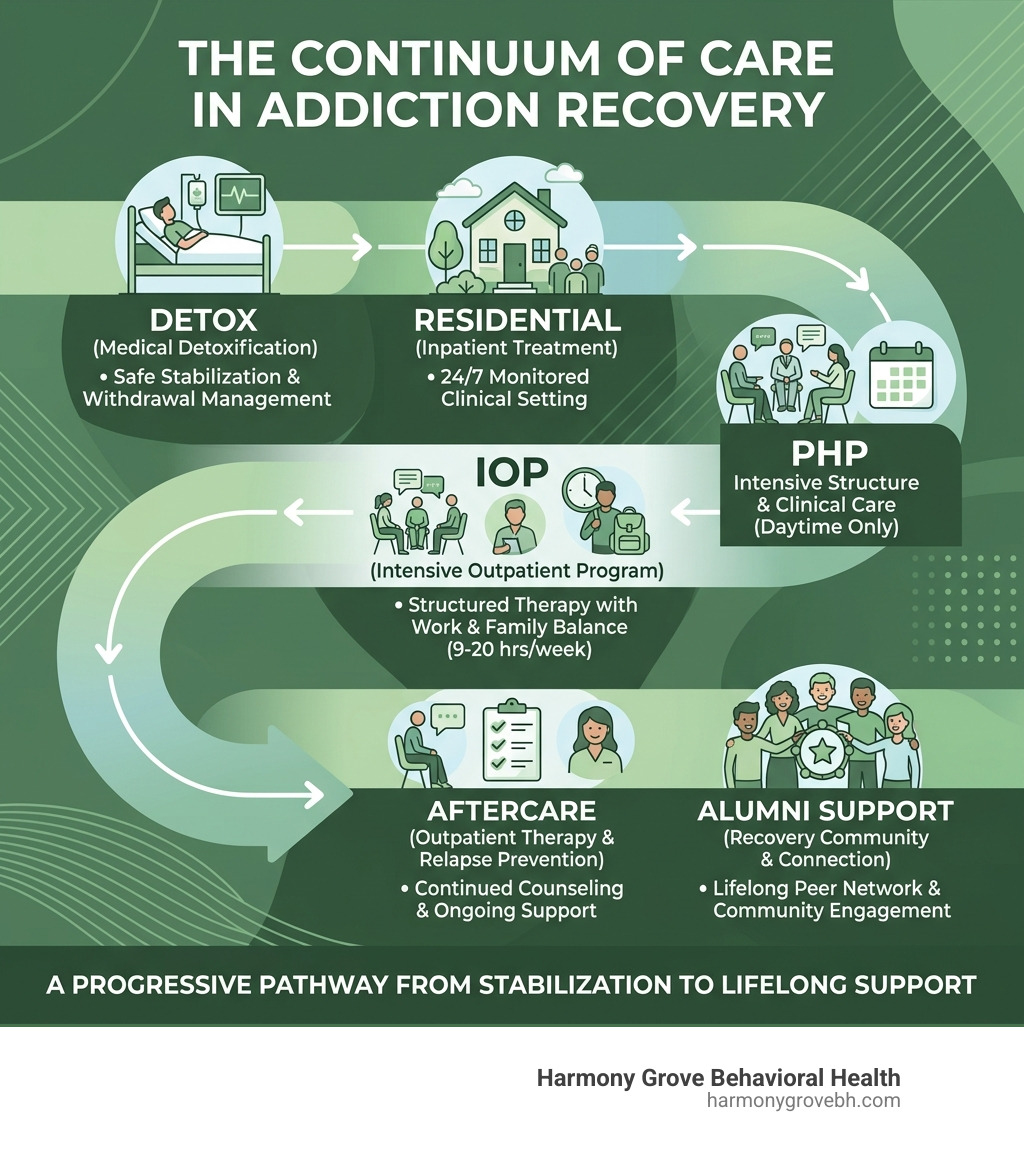
When people think of “rehab,” they often picture a secluded facility where they stay for 30 days. While residential treatment is vital for many, the addiction intensive outpatient houston model offers a different kind of clinical power. An Intensive Outpatient Program (IOP) is a level of care that provides significant clinical structure while allowing you to live at home.
In Houston, this model is designed to bridge the gap between high-intensity residential care and traditional weekly therapy. It follows the ASAM (American Society of Addiction Medicine) criteria, which helps clinicians determine the most appropriate level of care based on a person’s specific needs, risks, and strengths.
| Feature | Inpatient / Residential | Intensive Outpatient (IOP) |
|---|---|---|
| Living Situation | 24/7 on-site residency | Live at home or in sober living |
| Time Commitment | Full-time immersion | 9–20 hours per week |
| Work/School | Must take a leave of absence | Can maintain career or education |
| Supervision | Constant medical/clinical oversight | Scheduled clinical sessions |
| Cost | Generally higher due to room/board | More cost-effective |
For many, an IOP serves as essential step-down care. If you have recently completed a medical detox or a residential stay, jumping straight back into “normal life” can be a shock to the system. The IOP model acts as a safety net, providing professional support as you navigate real-world triggers for the first time in sobriety.
Who is a Candidate for Addiction Intensive Outpatient Houston?
Not everyone is a fit for outpatient care right away. To succeed in an addiction intensive outpatient houston program, certain criteria usually need to be met. We typically look for individuals who have a mild-to-moderate substance use disorder (SUD). If someone is experiencing severe, life-threatening withdrawal symptoms, they likely need a higher level of care, such as medical detox, before starting an IOP.
A stable home environment is also a major factor. Because you aren’t staying at a facility overnight, having a supportive, substance-free place to sleep is crucial. Candidates should also demonstrate a high level of treatment motivation. Since you have more freedom in an IOP, your “internal compass” needs to be pointed toward recovery. It is an ideal fit for:
- Professionals who cannot take extended leave from work.
- Parents and caregivers who have daily responsibilities at home.
- Students who need to stay on track with their education.
- Individuals transitioning out of a residential program who need continued accountability.
The Benefits of Choosing Addiction Intensive Outpatient Houston
The most immediate benefit of choosing a Houston-based IOP is the ability to maintain a work-life balance. You don’t have to put your life on pause to save it. You can attend therapy in the morning or evening and still be present for your family or your job.
Furthermore, IOPs are highly cost-effective. Because you aren’t paying for room and board, the financial barrier to high-quality clinical care is significantly lowered. Perhaps the greatest clinical benefit, however, is community integration. In a residential setting, you are in a “bubble.” In an IOP, you learn a new coping skill in group therapy at 10:00 AM and get to practice it in the real world by 6:00 PM. This real-time practice helps solidify sobriety in the environment where you actually live.
Core Therapies and Services in Houston Programs
The backbone of any successful addiction intensive outpatient houston program is its clinical curriculum. It’s not just about “talking about feelings”; it’s about utilizing evidence-based practices that have been scientifically proven to help rewire the brain and change behavior.

At the heart of our Intensive Outpatient Program are modalities like Cognitive Behavioral Therapy (CBT) and Dialectical Behavior Therapy (DBT).
- CBT: Helps you identify and challenge the “stinking thinking” or irrational thought patterns that lead to substance use.
- DBT: Focuses on emotional regulation, distress tolerance, and mindfulness. It is incredibly helpful for managing the intense cravings or emotional swings that often come in early recovery.
- Relapse Prevention: This is a core component where you develop a “battle plan” for triggers. You’ll identify your high-risk situations and create tangible strategies to navigate them without turning to a substance.
- Group Counseling: This is where the magic of community happens. Sharing experiences with peers who “get it” reduces the shame and isolation that fuel addiction.
Dual Diagnosis and Mental Health Integration
It is rare for addiction to exist in a vacuum. Often, individuals struggle with co-occurring disorders—meaning they are dealing with a substance use issue alongside a mental health condition like anxiety, depression, or PTSD. This is known as a dual diagnosis.
In high-quality Houston programs, treatment is integrated. This means we don’t just treat the drinking or the drug use; we treat the underlying depression or trauma at the same time. This often involves:
- Psychiatric Evaluations: Meeting with a board-certified professional to assess mental health needs.
- Medication Management: If medication is needed to stabilize a mood disorder or help with cravings, it is monitored closely by clinical staff.
- Trauma-Informed Care: Recognizing that many people use substances to numbing the pain of past trauma, and providing a safe space to process those experiences without re-traumatization.
Holistic and Experiential Approaches
While “talk therapy” is vital, we know that recovery involves the whole person—mind, body, and spirit. Many Houston programs now incorporate holistic services to round out the clinical experience.
Mindfulness and meditation are often used to help clients stay grounded in the present moment. Some programs offer trauma-sensitive yoga, which helps individuals reconnect with their bodies in a gentle, healing way. Expressive arts therapy allows for the processing of emotions that might be too difficult to put into words. Additionally, nutritional support and wellness goal-setting help repair the physical damage caused by long-term substance use, ensuring you feel as good on the inside as you look on the outside.
Scheduling and Time Commitment for an IOP Program Houston
One of the first questions people ask is, “How much time is this going to take?” It’s a fair question for someone trying to balance a busy life. In Houston, the standard time commitment for an IOP is between 9 and 20 hours of on-site programming per week.
A typical IOP Program Houston lasts about 8 to 12 weeks. However, this isn’t a “one-size-fits-all” timeline. Some people may progress through the curriculum in six weeks, while others might benefit from a longer stay of 16 weeks to ensure their foundation is rock-solid. The frequency of sessions usually starts high (perhaps 5 days a week) and gradually tapers down as you gain more stability and confidence in your recovery.
Flexible Options for Working Professionals
Houston is a city of industry—from the Energy Corridor to the Medical Center. We understand that our clients have high-stakes careers. To accommodate this, many programs offer flexible scheduling options.
- Morning Tracks: Ideal for those who work evening shifts or parents who need to be home when kids get out of school.
- Evening Tracks: Often running from 6:00 PM to 9:00 PM, these are perfect for the 9-to-5 professional who wants to maintain their career privacy while getting help.
- Virtual IOP / Telehealth: For those with long commutes or health concerns, virtual options provide the same high-level clinical care through secure, HIPAA-compliant video conferencing. This allows you to participate in group and individual therapy from the comfort of your home.
Family Involvement and Support Systems
Addiction is often called a “family disease” because it affects everyone in the household. Therefore, recovery should be a family process, too. Most Houston IOPs place a heavy emphasis on family therapy and education.
Family sessions help to heal the broken trust and damaged relationships that addiction leaves in its wake. This involves learning about the biology of addiction, improving communication skills, and—perhaps most importantly—setting healthy boundaries. When the family system learns how to support the individual without enabling the addiction, the chances of long-term success skyrocket.
Frequently Asked Questions about Addiction Intensive Outpatient Houston
How much does IOP cost and is insurance accepted?
Cost is a major concern for many families. The good news is that because an addiction intensive outpatient houston program does not include the high overhead of residential housing, it is much more affordable. Most major private insurance providers (such as Aetna, Blue Cross Blue Shield, Cigna, and United Healthcare) offer coverage for IOP services.
Our admissions team typically handles the insurance verification process for you, explaining exactly what your plan covers and what any out-of-pocket costs might be. For those without insurance, private pay options, sliding scale fees based on income, or financial assistance may be available to ensure that cost isn’t the thing standing between you and your life.
Can I transition to IOP from residential treatment?
Absolutely. In fact, this is often the recommended path. Transitioning from a 24/7 supervised environment directly back to a high-stress home or work life can lead to a quick relapse. Using an IOP as a step-down service provides a “buffer zone.” It allows for a gradual increase in autonomy while maintaining a high level of clinical accountability. During this phase, discharge planning becomes a focus, often involving recovery coaching and the identification of local support groups to ensure you have a “sober map” for your future.
What happens if a relapse occurs during the program?
In a high-quality IOP, a relapse is not viewed as a “failure” or a reason for immediate expulsion. Instead, it is seen as a clinical “red flag” that indicates a need for a treatment adjustment. If a client relapses, we perform a level of care assessment. We might increase the number of hours they spend in the program, suggest a temporary move to a sober living environment, or, if necessary, recommend a short return to residential stabilization. The goal is always accountability coupled with supportive intervention, often verified through regular, random drug screenings.
Conclusion
Finding the right addiction intensive outpatient houston program is about more than just finding a clinic; it’s about finding a community. At Harmony Grove Behavioral Health, located at 2855 Mangum Road in Houston, we are committed to providing holistic, community-focused care that treats the whole person.
Our approach combines evidence-based practices with trauma-informed programming to help you uncover the “why” behind your substance use. But our commitment doesn’t end when you finish the 8-week curriculum. We believe in lifelong aftercare and offer a robust alumni support network to ensure you never have to walk the path of recovery alone.
Recovery isn’t just about stopping the use of a substance; it’s about starting a new life where you don’t need that substance to cope, celebrate, or survive. If you are ready to take that first step toward a forever recovery, we are here to walk with you.