
When You Need More Than Weekly Therapy — But Not a Hospital Stay
Behavioral health IOP Houston programs offer a structured middle ground for adults who need serious support without putting their life on hold.
Here’s a quick look at what Houston IOPs typically offer:
| Feature | Details |
|---|---|
| Hours per week | 9–20 hours of therapy |
| Schedule | 3–5 days per week |
| Session length | 3–4 hours per session |
| Format | In-person or virtual |
| Who it’s for | Adults stepping down from inpatient care or needing more than weekly therapy |
| Conditions treated | Depression, anxiety, PTSD, substance use, dual diagnosis, and more |
| Insurance | Most major plans accepted (Aetna, BlueCross, Cigna, UnitedHealthcare) |
| Houston providers | 89+ IOP treatment centers listed in the Houston area |
If you’re balancing a career, family, and a real struggle with alcohol, substances, or trauma — you’re not alone. Nearly one-third of U.S. adults will experience an anxiety disorder at some point. Millions more face addiction, mood disorders, and trauma that don’t just go away with a weekly therapy appointment.
The problem is that most people don’t know what level of care actually fits their life. Full inpatient treatment isn’t always necessary — or realistic. But standard outpatient therapy once a week isn’t always enough either.
That gap is exactly where a behavioral health IOP fits in.
This guide will walk you through how to find a trauma-informed IOP in Houston that matches your schedule, your needs, and your goals — so you can get real support without walking away from your life.
Understanding Behavioral Health IOP Houston: A Flexible Path to Recovery
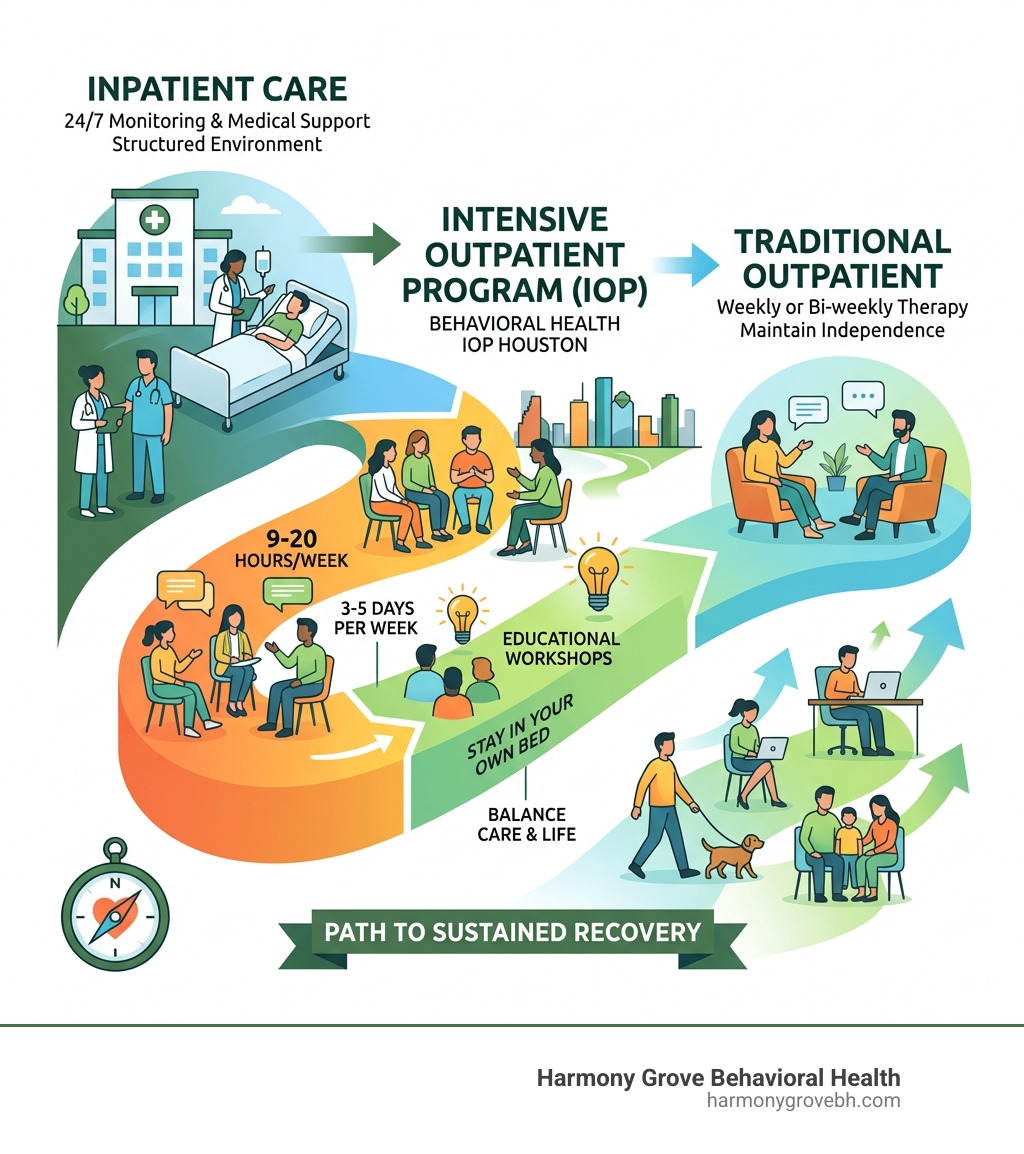
When we talk about an Intensive Outpatient Program (IOP), we are describing a specific “level of care” that sits between traditional once-a-week therapy and more restrictive settings like inpatient hospitalization. In the context of behavioral health iop houston, this model is designed to provide high-level clinical support while allowing you to sleep in your own bed at night.
For many of our neighbors in Houston, an IOP serves as a vital step-down care option. Perhaps you have just completed a residential stay or a Partial Hospitalization Program (PHP) and aren’t quite ready to navigate the world entirely on your own. Or, perhaps your symptoms have intensified, and your weekly therapist has suggested you need a “step-up” in support to prevent a crisis.
The beauty of the IOP model is that it fills a “treatment gap.” It provides the stabilization needed to manage intrusive thoughts, compulsions, or substance cravings without requiring you to quit your job or leave your family for a month. You get the benefit of a multidisciplinary team—including therapists and psychiatrists—while maintaining your daily responsibilities.
Comparing Levels of Care
To help you visualize where an IOP fits, consider this breakdown:
| Program Type | Weekly Hours | Supervision | Living Situation |
|---|---|---|---|
| Inpatient/Residential | 24/7 | Constant Clinical | On-site Facility |
| Partial Hospitalization (PHP) | 25–30 Hours | High (Daytime) | Home or Sober Living |
| IOP (Intensive Outpatient) | 9–20 Hours | Moderate (Sessions) | Home or Sober Living |
| Standard Outpatient | 1–2 Hours | Minimal | Home |
5 Key Factors for Selecting a Trauma-Informed Program
Choosing the right facility among the many Intensive Outpatient Program Treatment Centers in Houston, TX can feel overwhelming. You aren’t just looking for a clinic; you’re looking for a patient milieu—a community of peers and professionals where you feel safe enough to heal.

Here are the five pillars we recommend looking for:
- Trauma-Informed Framework: This is non-negotiable. A trauma-informed program understands that “symptoms” like addiction or outbursts are often coping mechanisms for past wounds. They prioritize safety, choice, and empowerment.
- Evidence-Based Practices: Ensure the center uses methods backed by science, such as CBT or DBT, rather than just “talk therapy.”
- Specialized Populations: Some programs are tailored for veterans, LGBTQ+ individuals, or professionals. Finding a group that “gets” your specific life experience can accelerate healing.
- Dual Diagnosis Capability: If you are struggling with both mental health and substance use, you need an integrated team that treats both at the same time. Treating one without the other is like trying to fix a leaky pipe by only mopping the floor.
- Personalized Care: Avoid “cookie-cutter” curriculums. Your treatment plan should be based on a comprehensive psychosocial evaluation that looks at your unique history and goals.
Evaluating Therapeutic Approaches in a Behavioral Health IOP Houston
A high-quality behavioral health iop houston will offer a diverse “menu” of therapeutic modalities. We believe that healing happens best when we engage the mind, the body, and the spirit.
Common approaches include:
- Cognitive Behavioral Therapy (CBT): Identifying and changing the thought patterns that lead to self-destructive behaviors.
- Dialectical Behavior Therapy (DBT): Learning specific skills for emotion regulation, distress tolerance, and interpersonal effectiveness.
- EMDR (Eye Movement Desensitization and Reprocessing): A specialized tool for processing traumatic memories so they no longer trigger a “fight or flight” response.
- Holistic Wellness: Many Houston programs now incorporate mindfulness, yoga, and even expressive arts to help regulate the nervous system.
- Group Therapy: This is the core of the IOP experience. In a group setting, you realize you aren’t alone. You practice new communication skills in a “mini-laboratory” of peers.
- Relapse Prevention & Psychoeducation: Learning the neuroscience behind your condition helps remove the shame and gives you practical tools for long-term stability.
Learn more about treating co-occurring disorders and how integrated therapy makes a difference.
Scheduling and Accessibility for Your Behavioral Health IOP Houston
Houston is a massive city, and we know that traffic on the 610 Loop or I-45 can be a barrier to care. When selecting an IOP in Houston Texas, logistics matter just as much as the clinical philosophy.
Most programs require a commitment of 9 to 20 hours per week, usually spread across three to five days. To make this work with your life, look for:
- Evening Tracks: Perfect for professionals or parents who need to work during the day. These sessions often run from 6:00 PM to 9:00 PM.
- Virtual IOP: Many centers now offer high-quality telehealth options. This is a game-changer for those with transportation issues or those who live in surrounding areas like Sugar Land or Katy but want Houston-level expertise.
- Commute Times: Consider a location that is easily accessible from your home or office to reduce the stress of getting to group on time.
Conditions Treated in Houston Intensive Outpatient Programs
You might be wondering if your specific struggle is “enough” for an IOP. The truth is, these programs are designed to handle a wide spectrum of behavioral health challenges.
Common conditions treated in a behavioral health iop houston include:
- Depression and Bipolar Disorder: Managing the highs and lows that make daily life feel unmanageable.
- Anxiety and Panic Disorders: Helping those who feel “stuck” at home or plagued by persistent worry.
- PTSD and Trauma-Related Issues: Addressing the root causes of emotional distress.
- Substance Use Disorders: Providing the structure needed to maintain sobriety while living at home.
- Dual Diagnosis: Treating co-occurring mental health and addiction issues simultaneously. Read more about dual diagnosis treatment in Houston.
- Personality Disorders: Building skills for better relationship health and emotional stability.
- Suicidal Ideation: Providing a higher level of safety and monitoring for those who have stabilized but still feel vulnerable.
Navigating Costs and Insurance for Houston Behavioral Health Services
We understand that the financial aspect of treatment can be stressful. However, we want to reassure you that most behavioral health iop houston programs are covered by major insurance carriers.
When you call a facility, the first step is usually insurance verification. Most centers work with:
- Aetna
- BlueCross BlueShield
- Cigna / Evernorth
- UnitedHealthcare / Optum
- TRICARE (for veterans and military families)
Understanding your coverage for behavioral health in Houston is essential. The admissions team will typically do the heavy lifting for you—they will call your provider, verify your benefits, and explain any out-of-pocket costs like deductibles or co-pays before you ever commit to a session.
If you don’t have insurance, many Houston facilities offer self-pay plans or can point you toward financial aid resources. The cost of untreated mental health or addiction issues—in terms of lost work, medical bills, and relationship strain—is almost always higher than the cost of a structured program.
Frequently Asked Questions about Houston IOPs
How many hours a week is a typical IOP?
In Houston, most Intensive Outpatient Programs require between 9 and 20 hours of clinical support each week. This typically looks like 3-hour sessions, 3 to 5 days per week. For example, a common schedule is Monday, Wednesday, and Friday from 9:00 AM to 12:00 PM, or an evening track from 6:00 PM to 9:00 PM.
Can I continue working while in an IOP?
Yes! In fact, that is one of the primary reasons people choose an IOP. By offering daytime, evening, and even virtual tracks, these programs allow you to maintain your career, attend school, or care for your children while receiving intensive therapy. It’s about integrating recovery into your “real life” rather than escaping from it.
What is the difference between IOP and PHP?
The main difference is the clinical intensity and time commitment. A Partial Hospitalization Program (PHP) is essentially a full-time job—usually 5 to 6 hours a day, 5 days a week. It is for those who need a very high level of structure. An IOP is the next step down, offering fewer hours and more flexibility, making it ideal for those who have achieved a baseline of stability but still need professional support to prevent relapse.
Conclusion
Finding the right behavioral health iop houston is about finding a balance between clinical excellence and practical flexibility. You deserve a program that doesn’t just treat your symptoms, but sees you as a whole person with a life worth living.
At Harmony Grove Behavioral Health, we are proud to serve the Houston community from our location on Mangum Road. Our approach is rooted in the belief that recovery is a lifelong journey, and you shouldn’t have to walk it alone. We offer holistic, community-focused care that combines evidence-based practices with deep trauma-informed programming.
Whether you are stepping down from a higher level of care or seeking intensive support for the first time, we are here to help you restore balance, resilience, and confidence.
Learn more about our Intensive Outpatient Program and how we can support your next chapter today.